GenAI meets Gen Z: What it means for Early Careers hiring
Now available on demand
Join Unseen and PeopleScout for a session exploring how generative AI is reshaping early careers hiring and what employers should do about it.
GenAI isn’t just changing how candidates apply. It’s changing how they prepare, how they present themselves, and how they engage with the hiring process. And importantly, most candidates are trying to use AI ethically to put their best foot forward.
Built around insights from PeopleScout’s latest report, GenAI meets Gen Z, this session will unpack what these shifts mean in practice and how employers can build a clear, thoughtful strategy in response.
From application through to assessment and onboarding, we’ll explore how hiring approaches need to evolve to stay fair, credible, and effective in an AI-enabled world.
Watch on demand now
What we cover
How GenAI is shaping candidate behaviour
Understand how students and graduates are using AI across applications, assessments, and preparation and why this is less about misuse, and more about evolving expectations.
Rethinking assessment in an AI-enabled world
If AI is here to stay, how do you design processes that remain fair and credible? We’ll explore how to assess not just outputs, but how candidates use AI judgment, transparency, and decision-making.
Building an AI-aware early careers strategy
Learn how to adapt your attraction, assessment, and selection approach setting clear expectations, encouraging ethical AI use, and improving confidence in hiring decisions.
What you take away
Key insights from the GenAI meets Gen Z report
Practical ways to respond to AI in your hiring process
A clearer strategy for assessing talent in an AI-enabled world
A recording of the session to revisit and share
Speakers
Nicola Sullivan
Partnership Solutions Director Unseen
James Chorley
Talent Solutions Director PeopleScout
Pip Wright
Talent Systems Technologist Unseen
Amanda Callen CPsychol AFBPsS FRSA
Head of Assessment Design PeopleScout
Rethinking early careers: What employers need to redesign in 2026
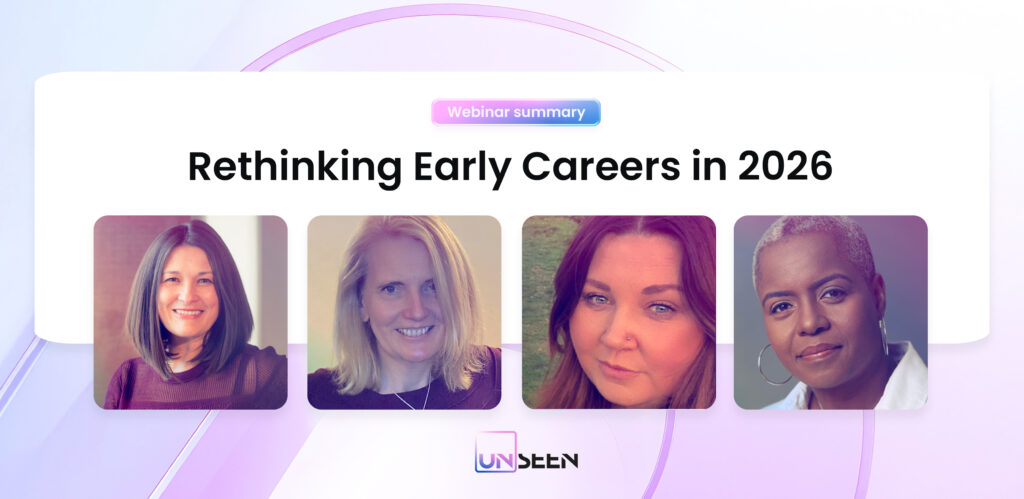
This article is a summary of a webinar discussion that took place on March 17 2026.
Titled Rethinking Early Careers: What needs to change in 2026, the webinar featured:
Ali Hackett, Director of Customer Experience at Unseen
Anne Marie Campion, Emerging Talent Specialist at Institute of Student Employers
Claire Monks, Graduate Programme Manager at NHS Wales
Dr Frances Trought, Founder of Everything D&I
The early careers market has always evolved, but this year feels materially different.
In our specialist early careers webinar, senior voices from across early careers, education and workforce strategy agreed that employers are now operating in a structurally different environment from just a year or two ago. 2026 is a year shaped by economic pressure, policy change, rising candidate anxiety, unprecedented application volumes and the accelerating impact of AI.
The result is a growing gap between how many organisations still recruit early talent and what candidates and businesses now need from those processes.
A more volatile market is changing how employers plan
One of the clearest themes from the discussion was that traditional annual planning cycles are becoming harder to sustain.
Rapid shifts in hiring demand, budget scrutiny, apprentice reform and wider economic uncertainty are making long-term talent planning less predictable than before. Our expert panel reflected that strategies which might once have remained stable for a year can now feel outdated within months.
That pressure is forcing employers to move beyond inherited recruitment cycles and towards more deliberate workforce planning: understanding which roles are likely to change, which skills will remain critical and where future pipelines genuinely need investment.
AI is no longer a side issue in early careers
The conversation confirmed that the debate has moved on from whether candidates should use AI, into accepting the reality that its use is prevalent.
Candidates are already using it, employers are using it, and trying to remove it from recruitment entirely is increasingly unrealistic.
The more important challenge now is how organisations respond fairly and intelligently.
This includes:
Deciding where AI use is acceptable in applications
Understanding how it affects assessment validity
Addressing unequal access to paid AI tools
Distinguishing between assisted responses and genuine judgement
Several speakers noted that many established selection methods are becoming less effective in this context. Generic written answers, CV screening and predictable competency questions are now easily generated or strengthened through AI.
The implication is not to remove rigour, but to redesign it, placing greater weight on judgement, authenticity and live interaction.
Related solution
Rethink assessment for a changing candidate landscape
As traditional screening methods become less effective, assessment needs to reflect how people think, solve problems and respond in real situations. Our Digital Assessment Centre platform, TopScore, helps employers assess potential more fairly and consistently.
A strong consensus emerged that assessment processes need to become more representative of how people will actually work.
If AI will be part of day-to-day working environments, then excluding it entirely from recruitment creates an artificial test.
Instead, employers should increasingly assess:
How candidates think
How they solve problems
How they apply judgement
How they use tools responsibly
That points towards more situational tasks, more project-based exercises and more live interaction, particularly later in the process.
At the same time, panellists acknowledged the practical tension this creates: face-to-face assessment and richer interaction often require more resource at a point when many teams are being asked to deliver more with less.
The confidence gap is now a major recruitment issue
One of the most important insights from the webinar was that candidate behaviour is being shaped not only by competition, but by confidence.
Across sectors, employers are seeing:
Higher anxiety
Lower certainty
Greater fear of rejection
Increased disengagement between offer and start date
For many young people, repeated rejection is no longer just part of the process but an experience that it is affecting confidence in education choices, career direction and whether they belong in professional environments at all.
That means candidate experience is no longer a secondary consideration. It has become central to conversion and retention.
Several speakers argued that employers need to think much more carefully about:
How rejection is handled
Where clarity is missing
How transparent entry requirements really are
Whether candidates understand what is expected of them
Even simple improvements in communication can materially change outcomes.
Related solution
Build confidence before day one
When candidates feel informed, connected and reassured, they are more likely to stay engaged throughout the journey. Unseen’s Candidate Experience & Onboarding platform, Meet & Engage, helps employers create stronger touchpoints before offer, after offer, and through onboarding.
Human connection matters more than ever before day one
A particularly strong theme was that organisations often underestimate how fragile the period between offer acceptance and start date has become.
This is where doubt grows, competing offers strengthen, and silent drop-off happens.
What prevents that is rarely process alone. It also about relationships and authenticity.
The most effective examples shared all involved stronger human contact:
Manager introductions
Buddy relationships
Early cohort engagement
Invitations to informal events
Clearer onboarding support
Practical visibility of what the first weeks will look like
As one panellist put it, organisations that retain talent best are often those that continue recruiting candidates emotionally right up until day one.
Skills-based thinking must go further
Another major point was that many organisations still talk about skills-based hiring more than they fully practise it.
Rigid academic filters, narrow qualification assumptions and institutional bias can still close off talent unnecessarily.
The panel challenged employers to think more carefully about aptitude, transferable capability and demonstrated potential – particularly where future roles are changing quickly anyway.
This matters not only for fairness, but for long-term talent resilience.
If organisations continue selecting only through familiar indicators, they risk reproducing the same talent profiles while missing the wider capabilities increasingly needed in a changing market.
Education and employers need closer alignment
A repeated concern was the widening disconnect between what education systems are producing and what employers expect.
Universities, schools and colleges are under pressure themselves, often being asked to support more students with fewer resources.
At the same time, employers continue to expect stronger work-readiness, AI fluency, data literacy and commercial understanding.
The discussion suggested that solving this cannot sit with one side alone. More partnership is needed:
Earlier exposure to employers
More meaningful insight experiences
Micro-internships and challenge-based learning
Stronger collaboration around future skill needs
The strongest examples are those that help young people understand work before formal application begins.
The strategic shift for employers
Taken together, the discussion pointed to a clear conclusion:
The organisations likely to succeed in early careers now will be those that stop treating recruitment as a fixed annual process and start treating it as a connected talent system – one that combines planning, assessment, communication, development and belonging.
The external pressures are unlikely to ease soon.
But many of the strongest responses are within employers’ control:
Simplify where complexity adds little value
Redesign outdated assessment steps
Build trust earlier
Communicate more clearly
Create stronger bridges between attraction and retention
In a market where candidates have more uncertainty and employers have less margin for error, the organisations that feel most human are often the ones that perform best.
Watch on demand
Hear the full discussion
This article captures some of the key themes from the conversation, but the full webinar explores the practical challenges, audience questions and panel perspectives in much greater depth.
Unseen Group acquires employee content platform Seenit
Unseen Group has announced the completion of its 11th acquisition with the addition of employee content platform, Seenit.
Seenit is an employee-generated video tool that has enabled the likes of Amazon and Vodafone to build authentic, high-impact content that boosts talent attraction, retention and development.
The deal comes as Unseen relaunches with a new website and unified offering, designed to help large-scale employers make fair, data-driven hiring decisions while delivering exceptional candidate and employee experiences.
“I’m really pleased to introduce Seenit to the Group and I look forward to exploring how its employee-generated content platform can support our clients and partners at a time when demand is growing for more human-centred and data-driven talent solutions,” said Zac Williams, CEO of Unseen Group.
“Seenit is a perfect fit for our refined employer-led offering and further solidifies Unseen as a leading provider of talent tools, spanning from candidate engagement, through to screening, assessments, onboarding and employee development,” he continued.
Emily Forbes, Founder of Seenit, said this about joining the Unseen Group:
“From my first meeting with Zac, it was clear our missions were aligned and that Unseen was building something ambitious. I’m incredibly proud of what we’ve achieved at Seenit, and joining Unseen gives us the opportunity to scale that impact even further. There’s a lot for us to look forward to now as we enter this next chapter of growth.”
“Our goal has always been to see employee content embedded across the entire talent lifecycle as it continues to play a critical role in how candidates understand, join and grow within organisations. Being a part of Unseen allows that voice to sit alongside the Group’s existing engagement, assessment, onboarding, and development tools where it can have even greater impact.”
Unseen Group’s strategic re-launch is a response to wider changes in recruitment sectors as advances in AI continue to impact how candidates search and apply for jobs – as well as how employers evaluate AI-assisted applications.
“We’ve seen a real shift in priorities,” said Zac, “employers are under increasing pressure to cut through with content that feels genuine and recruitment and development stages that feel innovative and immediate. The addition of Seenit and employee-led video builds authenticity and real connection at scale and that’s becoming a critical differentiator in a market shaped by AI and automation.”
Unseen was advised by JMW (Legal), Cowgills (FDD), Unity (Tax), Megabuyte (Commercial) with support from Pelican Capital and ThinCats.
year Seenit was introduced by Amazon’s Employer Brand team
The Challenge
Amazon needed to hire at scale while competing with some of the world’s most recognised technology employers. At the same time, the business needed a more authentic way to showcase what it is really like to work at Amazon.
Traditional job descriptions alone weren’t enough to explain complex roles or bring the organisation’s culture to life. To attract the next generation of candidates, Amazon needed to amplify employee voices and show genuine experiences from inside the company.
The Employer Brand team also needed a way to create this content efficiently and consistently across a large global organisation.
Objectives
Key objectives of the brief
Support high-volume hiring
Help Amazon attract talent at scale while competing with leading technology companies.
Build brand trust
Amplify employee voices to showcase authentic culture and values.
Humanise complex roles
Make specialist roles easier to understand and more appealing to potential candidates.
Create scalable content
Enable teams to generate authentic employee stories quickly and consistently.
Our Solution
Seenit was introduced by Amazon’s Employer Brand team in the Retail division in 2018. The platform enables Amazon employees to capture and share video content that brings their experiences to life.
By gathering stories directly from employees, Amazon can create authentic employer brand content that showcases career opportunities, culture and day-to-day experiences across the organisation.
The content can then be used across the candidate journey, including careers pages, social media and recruitment campaigns.
Results
Over time, Amazon has used Seenit to build a large library of employee-generated video content that supports both employer branding and recruitment campaigns.
Employee storytelling has helped Amazon increase engagement with employer brand content while giving candidates a clearer, more human view of what it is like to work at the organisation.
Notable outcomes
1,500+
employee video uploads captured through Seenit
15,000+
pieces of content created using the platform
2x
increase in click-through rate to jobs pages
+200%
increase in careers site traffic
Looking Ahead
Amazon continues to use Seenit to create employee-generated video content that supports employer branding and recruitment campaigns. By putting real employee voices at the centre of its storytelling, the organisation can showcase culture, roles and opportunities in a way that resonates with candidates globally.
“We were able to increase our careers site traffic by 200% and increase applications for quality candidates by 35%.”
Matt Sharp, Global EB Lead, Amazon
Bring employee stories to life
Discover how employee-generated video can help you showcase authentic culture, engage talent and scale your employer brand.
Engaging assessment experience with enterprise-grade insight
1
bespoke tool built around NatWest’s framework, not retrofitted to software
360°
capability view, from colleague development to bank-level insight
✓
governance-ready approach to data privacy and security requirements
The Challenge
NatWest had recently launched a new skills and behaviour framework and wanted to embed it across the bank in a way that felt practical for colleagues and valuable for leaders.
The team had already built an internal prototype tool. It was basic, but its early success proved there was real appetite for a more polished experience. To scale adoption and unlock meaningful insight, NatWest needed an external partner that could design and build something bespoke to their framework, with a strong focus on user experience.
As a highly regulated organisation, data privacy and security were critical. Any supplier would need to meet stringent governance and supply chain requirements.
Objectives
Key objectives of the brief
Embed the framework
Give colleagues something tangible to guide development and build consistent capability language.
Make it engaging
The solution needed a strong focus on an engaging and innovative user experience.
Unlock insight
Enable flexible analysis and reporting to inform development activity at an aggregate level. Create a clear view of technical capability across the bank.
Meet governance standards
Ensure data privacy, security and supplier assurance requirements were fully satisfied.
Our Solution
NatWest partnered with Evolve Assess to build a simple, attractively designed assessment experience tailored to their frameworks, rather than adopting an off-the-shelf product and retrofitting the framework to match.
Evolve worked closely with NatWest’s stakeholders, taking an open and collaborative approach to shaping the solution and suggesting alternative routes where needed to meet bespoke requirements.
Throughout delivery, Evolve supported NatWest’s governance and supply chain processes, providing the assessments, certificates and evidence required to meet strict data privacy and security standards.
Results
The platform helped NatWest embed skills and behaviour frameworks across the bank, giving colleagues a practical tool to support development and enabling leaders to access stronger capability insight.
The analysis centre in particular became a standout outcome, giving NatWest the ability to shape and cut skills data in the ways the business needed, and to use those insights to inform development activities at an organisational level.
Notable outcomes
Adoption
Framework embedded via a tangible, colleague-friendly experience.
Insight
Aggregate capability data available to inform bank-wide development planning.
Flexibility
Analysis centre enabled data to be shaped and interrogated in multiple ways.
Looking Ahead
Following the success of the initial project and the strength of the working relationship, NatWest has since gone on to develop several additional tools with Evolve in this space.
“Our dedicated relationship manager has been great, really responsive, just excellent at anticipating our needs.”
Lucy Downs, Behavioural Science Manager, NatWest
“If you are looking to build an engaging online assessment, I really recommend Evolve Assess. From design to delivery, they’ve been proactive, understood the business and the requirements, and helped build a really innovative solution going forward.”
Kier Group are a leading provider of infrastructure services, construction and property developments. After a couple of years using an assessment platform with significant challenges throughout, the Kier Group team were very sceptical about using another assessment platform and confidence was low.
With their graduate intake for 2025 increasing by 40% compared to 2024 resulting in a candidate pool of over 200, Kier needed a streamlined process that was easy to use, reliable, and effective.
Our Solution
Using TopScore to facilitate their in person and virtual assessment events gave Kier Group a seamless digital solution for their recruitment process.
With the ability to instantly change exercise materials and assessors when needed, along with the self-administration of exercise content, TopScore’s features were described as ‘an absolute game changer’ for Kier.
As Kier Group work in an ever-changing environment with the needs of the business shifting dramatically from day to day, having the ability to seamlessly adapt ensured a positive response from both candidates and assessors, and increased confidence across our stakeholder population.
Results
The Kier Group team grew in confidence around using an assessment platform thanks to the delivery of the project in full.
Feedback from the Kier team has been excellent, and all have expressed how intuitive and user friendly the TopScore interface is.
More importantly, Kier Group’s key business stakeholders have been extremely impressed, and comments such as ‘Can I use this for all of my interviews?’ and ‘Am I doing something wrong, it seems too easy?’ are a testament to the work that [the team] has dedicated to making the platform as simple and effective as possible.
Results
100%
of the assessors who said they experienced a significant improvement compared to the previous platform used
Looking Ahead
Feedback following the use of the Unseen’s assessment centre product has been so positive for Kier Group that they are now in the process of initiating a trial with an external partner to review the use of TopScore across all their Emerging Talent pathways.
The use of TopScore to provide an inclusive assessment structure and content, and the ability to ensure candidates are assessed fairly throughout the process, will be a key target of the trial.
In summary, I’ve personally been really impressed with both the platform and the support provided, it was a big gamble after the negative experience with a similar platform but my faith has been restored!! A massive thank you to Joe and Adam for their continued support and we’re looking forward to a long partnership!
Craig Melvin, Emerging Talent Recruitment Manager
Ready to transform your assessment centres?
Discover how Unseen can improve your assessment and hiring process without compromising on candidate experience.
Discover how to balance automation with empathy to attract, engage, and retain the next generation of talent
Behind every emerging talent application is a future leader. But in a world of mass applications, automation, and limited recruiter time, how do you make each candidate feel seen, valued, and inspired to join you?
This exclusive whitepaper by Meet & Engage brings together leading voices from HSBC, Grant Thornton, Costain and Teesside University, along with expert opinions from around the Unseen Group, sharing evidence-based strategies to help you:
Deliver high‑volume hiring without sacrificing quality
Build psychologically safe processes that reduce stress and disengagement
Use technology to scale fairness and efficiency while preserving the human touch
Forge powerful employer‑university partnerships for future‑ready talent
Create early careers journeys that leave candidates feeling valued and engaged
Whether you’re running a graduate scheme, scaling apprenticeships, or reimagining onboarding, this whitepaper provides practical frameworks, case studies, and actionable takeaways to help you stay ahead.