
Category: Blog

  • Rethinking early careers: What employers need to redesign in 2026 
    Rethinking early careers: What employers need to redesign in 2026 

    Rethinking early careers: What employers need to redesign in 2026 

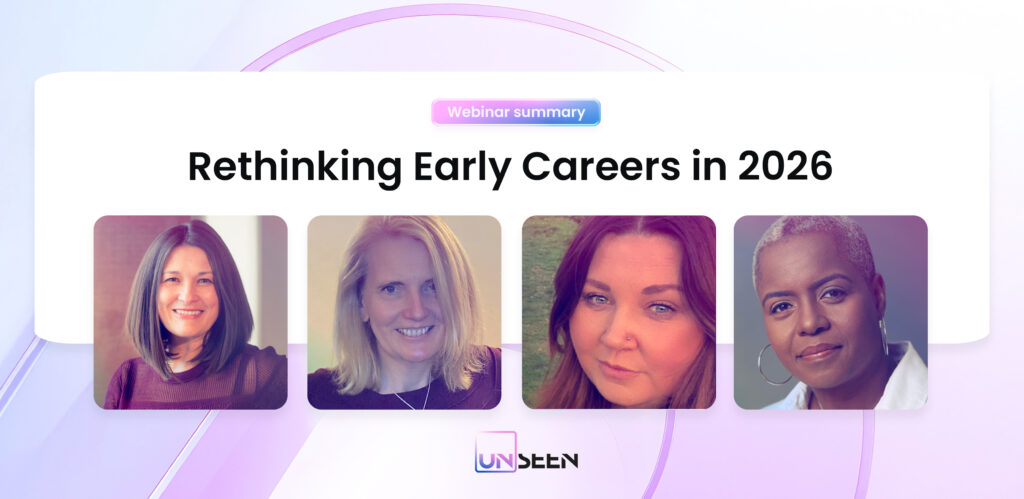
    This article is a summary of a webinar discussion that took place on March 17 2026.

    Titled Rethinking Early Careers: What needs to change in 2026, the webinar featured:

    Ali Hackett, Director of Customer Experience at Unseen

    Anne Marie Campion, Emerging Talent Specialist at Institute of Student Employers

    Claire Monks, Graduate Programme Manager at NHS Wales

    Dr Frances Trought, Founder of Everything D&I


    The early careers market has always evolved, but this year feels materially different. 

    In our specialist early careers webinar, senior voices from across early careers, education and workforce strategy agreed that employers are now operating in a structurally different environment from just a year or two ago. 2026 is a year shaped by economic pressure, policy change, rising candidate anxiety, unprecedented application volumes and the accelerating impact of AI. 

    The result is a growing gap between how many organisations still recruit early talent and what candidates and businesses now need from those processes. 

    A more volatile market is changing how employers plan 

    One of the clearest themes from the discussion was that traditional annual planning cycles are becoming harder to sustain. 

    Rapid shifts in hiring demand, budget scrutiny, apprentice reform and wider economic uncertainty are making long-term talent planning less predictable than before. Our expert panel reflected that strategies which might once have remained stable for a year can now feel outdated within months. 

    That pressure is forcing employers to move beyond inherited recruitment cycles and towards more deliberate workforce planning: understanding which roles are likely to change, which skills will remain critical and where future pipelines genuinely need investment. 

    AI is no longer a side issue in early careers 

    The conversation confirmed that the debate has moved on from whether candidates should use AI, into accepting the reality that its use is prevalent.  

    Candidates are already using it, employers are using it, and trying to remove it from recruitment entirely is increasingly unrealistic. 

    The more important challenge now is how organisations respond fairly and intelligently. 

    This includes: 

    • Deciding where AI use is acceptable in applications 
    • Understanding how it affects assessment validity 
    • Addressing unequal access to paid AI tools 
    • Distinguishing between assisted responses and genuine judgement 

    Several speakers noted that many established selection methods are becoming less effective in this context. Generic written answers, CV screening and predictable competency questions are now easily generated or strengthened through AI. 

    The implication is not to remove rigour, but to redesign it, placing greater weight on judgement, authenticity and live interaction. 

    Related solution

    Rethink assessment for a changing candidate landscape

    As traditional screening methods become less effective, assessment needs to reflect how people think, solve problems and respond in real situations. Our Digital Assessment Centre platform, TopScore, helps employers assess potential more fairly and consistently.

    Explore Digital Assessment Centre solutions

    Assessment needs to reflect real working life 

    A strong consensus emerged that assessment processes need to become more representative of how people will actually work. 

    If AI will be part of day-to-day working environments, then excluding it entirely from recruitment creates an artificial test. 

    Instead, employers should increasingly assess: 

    • How candidates think 
    • How they solve problems 
    • How they apply judgement 
    • How they use tools responsibly 

    That points towards more situational tasks, more project-based exercises and more live interaction, particularly later in the process. 

    At the same time, panellists acknowledged the practical tension this creates: face-to-face assessment and richer interaction often require more resource at a point when many teams are being asked to deliver more with less. 

    The confidence gap is now a major recruitment issue 

    One of the most important insights from the webinar was that candidate behaviour is being shaped not only by competition, but by confidence. 

    Across sectors, employers are seeing: 

    • Higher anxiety 
    • Lower certainty 
    • Greater fear of rejection 
    • Increased disengagement between offer and start date 

    For many young people, repeated rejection is no longer just part of the process but an experience that it is affecting confidence in education choices, career direction and whether they belong in professional environments at all. 

    That means candidate experience is no longer a secondary consideration. It has become central to conversion and retention. 

    Several speakers argued that employers need to think much more carefully about: 

    • How rejection is handled 
    • Where clarity is missing 
    • How transparent entry requirements really are 
    • Whether candidates understand what is expected of them 

    Even simple improvements in communication can materially change outcomes. 

    Related solution

    Build confidence before day one

    When candidates feel informed, connected and reassured, they are more likely to stay engaged throughout the journey. Unseen’s Candidate Experience & Onboarding platform, Meet & Engage, helps employers create stronger touchpoints before offer, after offer, and through onboarding.

    Explore Meet & Engage

    Human connection matters more than ever before day one 

    A particularly strong theme was that organisations often underestimate how fragile the period between offer acceptance and start date has become. 

    This is where doubt grows, competing offers strengthen, and silent drop-off happens. 

    What prevents that is rarely process alone. It also about relationships and authenticity.  

    The most effective examples shared all involved stronger human contact: 

    • Manager introductions 
    • Buddy relationships 
    • Early cohort engagement 
    • Invitations to informal events 
    • Clearer onboarding support 
    • Practical visibility of what the first weeks will look like 

    As one panellist put it, organisations that retain talent best are often those that continue recruiting candidates emotionally right up until day one. 

    Skills-based thinking must go further 

    Another major point was that many organisations still talk about skills-based hiring more than they fully practise it. 

    Rigid academic filters, narrow qualification assumptions and institutional bias can still close off talent unnecessarily. 

    The panel challenged employers to think more carefully about aptitude, transferable capability and demonstrated potential – particularly where future roles are changing quickly anyway. 

    This matters not only for fairness, but for long-term talent resilience. 

    If organisations continue selecting only through familiar indicators, they risk reproducing the same talent profiles while missing the wider capabilities increasingly needed in a changing market. 

    Education and employers need closer alignment 

    A repeated concern was the widening disconnect between what education systems are producing and what employers expect. 

    Universities, schools and colleges are under pressure themselves, often being asked to support more students with fewer resources. 

    At the same time, employers continue to expect stronger work-readiness, AI fluency, data literacy and commercial understanding. 

    The discussion suggested that solving this cannot sit with one side alone. More partnership is needed: 

    • Earlier exposure to employers 
    • More meaningful insight experiences 
    • Micro-internships and challenge-based learning 
    • Stronger collaboration around future skill needs 

    The strongest examples are those that help young people understand work before formal application begins. 

    The strategic shift for employers 

    Taken together, the discussion pointed to a clear conclusion: 

    The organisations likely to succeed in early careers now will be those that stop treating recruitment as a fixed annual process and start treating it as a connected talent system – one that combines planning, assessment, communication, development and belonging. 

    The external pressures are unlikely to ease soon. 

    But many of the strongest responses are within employers’ control: 

    • Simplify where complexity adds little value 
    • Redesign outdated assessment steps 
    • Build trust earlier 
    • Communicate more clearly 
    • Create stronger bridges between attraction and retention 

    In a market where candidates have more uncertainty and employers have less margin for error, the organisations that feel most human are often the ones that perform best.  

    Watch on demand

    Hear the full discussion

    This article captures some of the key themes from the conversation, but the full webinar explores the practical challenges, audience questions and panel perspectives in much greater depth.

    Watch the webinar on demand
  • Designing Your Selection Process: The Basics and Beyond

    Designing Your Selection Process: The Basics and Beyond

    The importance of a well designed selection process

    Hiring is expensive. Hiring twice when instead you could have got right the first time is very expensive.

    When it comes to hiring, properly designing a selection process is crucial. It allows you to identify and hire the right candidates who will contribute to the success of your organisation. A well-designed selection process ensures that you have a systematic approach in place to evaluate candidates based on their skills, qualifications, and what they can add to your company!

    By designing a selection process, you can avoid making hasty decisions and reduce the chances of making poor hiring choices. It provides a framework for consistent evaluation, enabling you to compare candidates objectively and make informed decisions.

    Below, we share insights into the 3 key steps of developing a successful and adaptable selection process, so you can ensure you’re choosing the appropriate measurement methods and ensuring fairness in candidate assessment.

    Step 1

    Conducting a thorough job analysis

    Before you can design an effective selection process, it is crucial to conduct a thorough job analysis. Job analysis involves gathering information about the tasks, responsibilities, and qualifications required for a specific job.

    During a job analysis, you can use various techniques such as interviews, observations, and surveys to collect data. It is important to involve subject matter experts who are familiar with the job to ensure accuracy and completeness of the information gathered. Conducting a thorough job analysis is an essential step in designing a selection process. It provides valuable insights into the job requirements and helps you create assessments that accurately measure the candidates’ suitability for the role.

Step 2

Choosing the right measurement methods

Your next step in designing a selection process is choosing the right measurement methods to effectively assess candidates’ skills, abilities, and qualifications.

There are various measurement methods available, including psychometric tests, structured interviews, and job-relevant work samples. Each method has its advantages and limitations, and it is important to select the ones that align with the job requirements and provide valid and reliable results.

Psychometric tests, such as cognitive ability tests and personality assessments, can provide valuable insights into candidates’ aptitude and characteristics. Structured interviews allow you to ask standardised questions and evaluate candidates’ responses consistently. Job-relevant work samples, such as case studies or simulations, provide a glimpse into candidates’ likely performance on important parts of the role.

When choosing the right measurement methods, it is essential to consider factors such as the job level, the number of candidates, and the resources available. By selecting the most appropriate methods, you can ensure accurate and fair assessment of candidates.

Step 3

Creating a valid assessment strategy

To ensure the validity and fairness of your selection process, it is important to create a valid assessment strategy.

Assessor training is also crucial in creating a valid assessment strategy. Assessors should be trained on how to conduct assessments, score candidates objectively, and avoid personal biases. Training ensures consistency and fairness in the evaluation process.

Regular calibration sessions can also be conducted to ensure that assessors are aligned in their evaluation standards. These sessions allow assessors to discuss and clarify any ambiguities in the scoring criteria, further enhancing fairness.

Conclusion

In summary, ensuring fairness through assessor training and objective scoring is crucial for an effective selection process that is also a positive experience for your candidates.

Speak to an expert

Share your goals and challenges with our qualified team to discover how Unseen can help you to hire your way.

  • Webinar: Rethinking Early Careers: What needs to change in 2026

    Webinar: Rethinking Early Careers: What needs to change in 2026

    Rethinking Early Careers:
    What Needs to Change in 2026

    Join Ali Hackett, Unseen’s Customer Experience Director, along with Anne Marie Campion, Emerging Talent Specialist at the Institute of Student Employers, and Dr. Frances Trought, DEI expert, in this forward-looking session.

    Together, they’ll be sharing what they’re seeing across the Early Careers market, and what needs to change.

    Watch on demand

    Enter your details to access the recording.

    The topics we’ll be covering:

    What feels different about this year’s early careers cycle

    Dive deeper into how the early careers landscape is being affected by work readiness challenges, skills gaps and early attrition.

    How attraction, engagement, assessment, and selection should evolve

    Learn how employers can balance efficiency with candidate experience as expectations shift and AI evolves.

    Where organisations risk losing talent

    Find out how you can strengthen engagement and work readiness between offer and start date, as we share advice on designing a more connected and resilient early careers strategy.

    Materials you will receive

    • A concise post-session summary with key takeaways
    • On-demand access to the webinar recording

    Meet the speakers


    Ali Hackett
    Customer Experience Director,
    Unseen

    Anne Marie Campion
    Emerging Talent Specialist,
    Institute of Student Employers

    Dr Frances Trought
    Founder,
    Everything D&I

    Claire Monks
    Graduate Programme Manager
    NHS Wales

    Watch now on demand

    Access the recording

  • 7 Principles of an Effective 360 Feedback Process 

    7 Principles of an Effective 360 Feedback Process 

    This article is adapted from a practical 360 feedback guide developed by Evolve Assess and Sten10, specialist psychometric and development practices within the Unseen Group.

    Download the full guide →

    360 feedback can be incredibly valuable – but only if it’s done well.

    A poorly planned 360 wastes time, frustrates people, and fails to deliver actionable insights. Luckily, when approached thoughtfully, a 360 process gives employees and leaders a clear understanding of how they’re seen, highlights blind spots, and drives real growth.

    Many organisations invest time and resources into 360s, but too often the results fall flat. A 360 isn’t just a survey or a report; it’s a structured process that builds a holistic view of performance and behaviour.

    Below, we outline seven practical principles to help you design and deliver a 360 feedback process that actually works.

    Principle 1

    Start with a clear ‘Why’

    Every effective 360 feedback programme starts with a clear purpose. Ask yourself: why are we collecting this feedback?
    A strong, development-focussed ‘why’ builds trust and engagement, helping participants see the process as a tool for growth, not a performance review.

    Focus on development, not evaluation:
    When feedback isn’t tied to promotions or appraisals, participants are more honest, and raters provide actionable insights.

    Be transparent:
    Explain how the process works, who sees the results, and how the insights will be used. Even a single sentence clarifying confidentiality can dramatically increase trust.

    Anchor your 360 in a clear, development-led purpose. It’s the foundation for feedback people value and act on.

    Principle 2

    Measure what actually matters

    A 360 is only useful if it assesses the behaviours and skills that truly impact performance and organisational goals. Avoid vague or overloaded questionnaires. Too many questions dilute insight and frustrate raters.

    Link to your purpose:
    Every question should tie back to your development-led ‘why’. If it doesn’t, cut it. Focus on the 6-8 competencies that matter most and include 1-2 open-ended questions for context.

    Prioritise relevance over volume:
    A concise, targeted survey keeps raters engaged and ensures feedback is actionable. A 360 is only useful if it assesses the behaviours and skills that truly impact performance and organisational goals. Avoid vague or overloaded questionnaires. Too many questions dilute insight and frustrate raters.

    Ask yourself, “Will this question help the participant grow in ways that benefit them and the organisation?” Only include items that pass this test to ensure feedback is both actionable and valuable.

    Principle 3

    Focus on observable behaviours

    Feedback is only useful when it’s specific and actionable. Avoid asking raters for subjective judgments like “Is this person a good leader?” Instead, focus on observable behaviours that can be clearly seen and measured.

    Why it matters:
    Behaviour-based items reduce bias, make feedback easier to interpret, and give participants concrete actions they can take to improve.

    Practical approach:
    Replace vague statements with clear, action-focused questions. For example, “How often does this person involve the team in decisions?” or “Does this person provide timely and constructive feedback?”

    Doing this creates clarity for both raters and recipients, giving you the rich insight you need.

    Principle 4

    Keep the questionnaire focussed and human

    Less is more when it comes to 360 surveys. Overly long questionnaires lead to rater fatigue, superficial answers, and lower data quality.

    Stick to the essentials:
    Focus on 6-8 core competencies and 25-40 rating items, plus 1-2 open-ended questions for context. This keeps feedback easy and concise.

    Make it easy to complete:
    Use simple, neutral language and avoid jargon or double-barrelled questions. Clear rating scales with defined anchors help raters provide consistent input.

    Remember, everyone involved is a human being – respect their time, speak to them on a level and the results will thank you for it.

    Want the complete 360 feedback framework?
    Get sample questions, rollout timelines, and debrief strategies.

    Download the full guide →
    360 Feedback Guide Cover
    Principle 5

    Choose technology that builds trust

    The right platform can make or break a 360 feedback process. Confusing technology is likely to result in even more confusing data.

    Prioritise usability:
    Choose a system that is intuitive, mobile-friendly, and easy for raters to navigate. Clear instructions reduce errors and increase engagement.

    Protect confidentiality:
    Trust is essential. Ensure anonymity is maintained, feedback is grouped appropriately, and sensitive data is secure. Participants must feel confident their input and results are handled responsibly.

    Clear reporting:
    Feedback reports should be simple to read, highlight key strengths and development areas, and present comparisons fairly. Psychologically sound design helps participants process information without feeling overwhelmed.

    Tip: Technology should support the 360 process, not become an obstacle. A trustworthy platform, such as Evolve Assess, sets the stage for honest, actionable feedback.

    Principle 6

    Roll out with clear communication

    Even the best-designed 360 will fail without a clear, structured rollout. How the process is introduced and managed sets the tone for engagement and trust.
    Secure senior sponsorship:
    A message from leadership reinforces purpose and credibility, showing participants that the 360 is taken seriously.

    Guide raters:
    Provide simple instructions on how to give feedback, focusing on observable behaviours and specific examples. Clear expectations prevent confusion and encourage meaningful input.

    Set timelines:
    Define deadlines for rater selection, survey completion, and report delivery. Automated reminders help maintain momentum and maximise participation.

    Treat the rollout like a mini-project. Clear communication, guidance, and deadlines ensure the process runs smoothly and feedback is taken seriously.

    Principle 7

    Turn feedback into real conversation

    The impact of a 360 depends on how feedback is delivered and acted upon. Simply sending a report isn’t enough, participants need guidance to interpret and apply what they’ve learned.

    Facilitated debriefs:
    A structured discussion with a manager, coach, or HR professional helps participants process feedback, explore patterns, and identify development priorities.

    Follow-up and coaching:
    Short coaching sessions or manager check-ins at 30, 60, or 90 days keep momentum going and increase the likelihood of lasting behaviour change.

    Treat feedback as the start of a conversation, not the end. Turning insights into action ensures the 360 drives real growth, builds trust, and delivers tangible results for both individuals and the organisation.

    Conclusion

    A 360 feedback programme is more than a survey. Done well, it builds self-awareness, trust, and meaningful development. Bringing in expertise, whether internal or through partners like Evolve Assess and Sten10, ensures your 360 is trusted, actionable, and genuinely impactful.

    Download the 360 Feedback Guide

    Get the full step-by-step guide, including sample questions, rollout timelines, and best-practice debriefing techniques.