How Coupang transformed hiring through employee video with Seenit
Harnessing the power of employee storytelling to drive business success.
About Coupang
Coupang is South Korea’s and Taiwans largest e-commerce company.
Fast-scaling growth and retention challenges mean Coupang must constantly refresh content to support aggressive recruiting goals/
Organisation
Coupang
Industry
E-Commerce
Scale
95,000 Employees
13 Global offices
Use Case
Showcase culture and employee storytelling
The Challenge
For Coupang, content production has to scale efficiently despite limited resources, and every asset must not only engage but also improve conversion metrics.
“Long Q&As weren’t being read; we needed authentic, engaging culture stories people actually watch.”
Timothy Schepis, Global Employer Brand Director at Coupang
How Coupang used Seenit
Employee storytelling
Creating employee-led video content using our AI video editing software.
Global collaboration
Getting amazing content from their team with our optimised uploading experience.
Employer brand
Generating a branded video that could be quickly embedded into or shared onto their channels for reach.
“Before Seenit, Coupang was doing employee storytelling through Q&A with long articles, and would post a photo, but people aren’t reading long articles anymore and we needed to find an authentic and more engaging way to showcase culture and our employees’ stories.”
Timothy Schepis, Global Employer Brand Director at Coupang
Impact across 4 years
3x
Video output
70%
VTR
5x
Views
8x
Click through
2x
Impressions
FTS Team Video Performance
Just one of hundreds of videos Coupang have created on Seenit.
20m+
Impressions
200
Applications
22
Interviews
2
Hires
“Seenit has evolved alongside us, as we’ve scaled and adapted. With the addition of Seenit’s AI functionality, it’s been especially impactful not only empowering my team to create more content, but also enabling us to deliver it faster and at a higher production quality.”
Book a demo of Seenit today
Discover the fastest way to get content from your team and turn it into
impactful stories.
Company culture is a bit of an abstract concept; many think they understand it, but few can define it or explain how their culture was developed and maintained.
What is company culture and how important is it to get right?
Let’s start with a definition of company culture. The Cambridge Dictionary defines corporate culture as:
‘The beliefs and ideas that a company has and the way in which they affect how it does business and how its employees behave.’
It’s a good definition; it seems logical, straightforward, and concise. The problem is, it all too often seems that not many companies define their culture this way. Moreover, don’t all companies (especially when you ask their leaders) purport to have a ‘good corporate culture’?
The problem with misunderstanding your culture
It seems logical that business founders will be responsible for establishing a company culture and defining what that culture should be.
This culture is typically based on the company founders’ own personal values, vision, and their preferred working environment – and that culture will be imparted to the next member of staff, then the next, then the next… this seems like a logical strategy – but this is where many businesses start to struggle.
When a company culture is defined this way, the first few members of staff all end up being just like the company founder(s), meaning they may all share the same personal values, vision and work environment preferences. This all sounds great, and the recipe for a productive work environment, but when you start to dig a little deeper, is the best recruitment policy to employ ‘people that the founders would enjoy having a beer with’?
It’s a fairly common example: ‘we have a great company culture… we all go out for a beer after work on a Friday!’
But does this really mean the company has a great culture? Who says? Does it also mean that those people who can’t/don’t want to join the Friday beer club, won’t be model employees, who fully buy in to the business’ values and goals?
Although the beer example might be quite extreme, the point is that the ‘pint after work’ definition of good company culture does nothing for the long-term success of the business.
As a business increases its revenue, inevitably, more staff are required to meet demands; new staff with new skill sets to be brought in and new processes are to be implemented to streamline operations. This requires recruiting a very different set of individuals, with different personalities and unique personal aspirations.
Culture and hiring
The effect of a badly-defined company culture
A badly-defined company culture leaves the hiring manager asking all the wrong questions in interviews: is this person going to get on well with the rest of the team? Do I have anything in common with them? Are they like me? Will they be a good cultural fit (will they fancy a beer on Friday after work)?
Now this is where mistakes are made by some:
It’s not so much unconscious bias on the part of the hiring manager, as it is them genuinely believing this person doesn’t represent a cultural fit with the company. The issue is, the very cultural fit against which the candidate is being measured, has been defined in the wrong way!
This means that the hiring manager, all through wanting to perpetuate a poorly- defined company culture, is potentially missing out on the best person/people for the vacancies.
‘If we mention all of these great things we do, will this candidate work 10-hour days and weekends when we need them to?’
The ‘Friday beer’ example was only provided to illustrate a point; there are so many other examples of badly defined company culture that are far more common, and often detrimental. And it’s not always driven by the founders’ own personal values, vision and preferred work environment – it’s often erroneously defined by other ways.
For example, wanting to present a culture that the company thinks that staff and prospective hires will want… but the reality is far different from the concept.
Having break-out areas, cool, edgy office furniture, and free snacks – the whole ‘work hard/play hard culture’, often translating to staff having to work 60 hours a week to be rewarded with a free Dominos at the end of the month, doesn’t feel like a great culture.
Of course, we’re not suggesting that every company that has these policies and perceived benefits in place are disingenuous – far from it! But it does happen far too often that staff are misinformed about the role, and that many hiring managers are assessing cultural fit by asking internal questions such as ‘if we mention all of these great things we do, will this candidate work 10-hour days and weekends when we need them to?’
Many growing businesses are struggling to effectively define their culture, but this is a key step that needs to be completed before you can start to hire for cultural fit – so, how can this be done?
Step 1
Establish an organisational values framework
Nowadays, it’s becoming more and more important to develop an organisational values model. Company values are the core set of beliefs that a company has and gives all staff the opportunity to get behind the same goals.
Some examples of company values could include:
Openness, transparency, accountability and creativity
When developing company values, take plenty of time to get it right; it’s pivotal and will underpin everything from hiring to strategy, process to profits. Brainstorm with your team, involve as many stakeholders as possible. Include staff, shareholder, customers, and suppliers – what are the traits we have as a business that we want to keep, what do we want to eliminate and what do we want to do that we don’t currently? Having a core set of company values sets in place will help to shape the company mission and vision.
Step 2
Implement a mission statement and document your vision
If you don’t have one already, implement a company mission statement, and a written vision that is communicated to all staff. It’s something that everybody can get behind if it’s done properly. Alongside values, it forms the foundation of company culture.
Although it’s a decision for company owners and leaders, it’s hugely important that collaboration with staff occurs to build this mission statement so everybody is bought in from the outset. The mission statement should encapsulate the business vision and why the business exists; it’s crucial. Additionally, Mission-driven workers are 54 percent more likely to stay at the company for 5 years.
A crucial step in building your new culture is to assess against your newly developed values. Carry out anonymous staff surveys to see how your current staff feel you’re performing against values. If, for example, once of your values is “we are open”, anonymously survey your staff to see if they believe the business is as open as it can be; ask open-ended questions to find out where the company is performing well, and not so well, and look to provide interventions based on areas of perceived weakness.
Step 3
Assess against your new values and mission
360 feedback assessments are also a crucial way of seeing how aligned an individual (particularly a manager – as they’re often responsible for employee dissatisfaction) is aligned to the organisational values, and its culture.
Structure a 360 assessment around organisational key values and competencies and have their managers, direct reports, peers, other colleagues and even customers rate the individual against these competencies and values. This is a fantastic way of being able to highlight how aligned, or misaligned an individual is to the values and culture of a company, and gives an individual the opportunity to receive constructive and honest feedback from people they work with.
By incorporating these tools into your internal processes, it gives each member of staff the opportunity to feed back and contribute to the cultural shape of the business, whilst at the same time giving ownership of individuals’ personal and professional journey. For the business, it hugely helps to shape the internal culture, ensuring that all members of staff know exactly what the culture is, how it’s been developed and how it should be upheld.
Step 4
Foster the culture
Once the above steps have been carried out, the management can start to foster the organisational culture. This will not happen overnight but done properly it can work wonders for businesses. It is the responsibility of, initially, the leadership team and subsequently the entire staff base to maintain a positive company culture, based on the values and mission. And it’s incredibly important for the culture to be inclusive for all.
If one of the values that is developed is ‘team spirit’ – don’t just put a pool table in the office: look to reward the entire team when things go well – organise team days that are inclusive to all. In addition to the pub Fridays, offer a suitable alternative to those staff that are unable to join – use some imagination and creativity!
For businesses that have ‘integrity’ as a core value, make sure you’re as ethical, fair, and honest with your staff as you are with your customers: update them on company financials, future plans and your expectations of them.
The list is endless, but you can probably see how having a robust core set of values in place, should impact all your stakeholders in the same way – it builds consistency and supports in building an incredible organisational culture.
Conclusion
Company culture is absolutely paramount and is pivotal to the success of a company. Making sure that your business has a culture to be proud of will help you get the most from your current staff base and ensure that you recruit those that align with your organisation – and who feel your organisation aligns with them!
Speak to an expert
Share your goals and challenges with our qualified team to discover how Unseen can help you to hire your way.
Rethinking early careers: What employers need to redesign in 2026
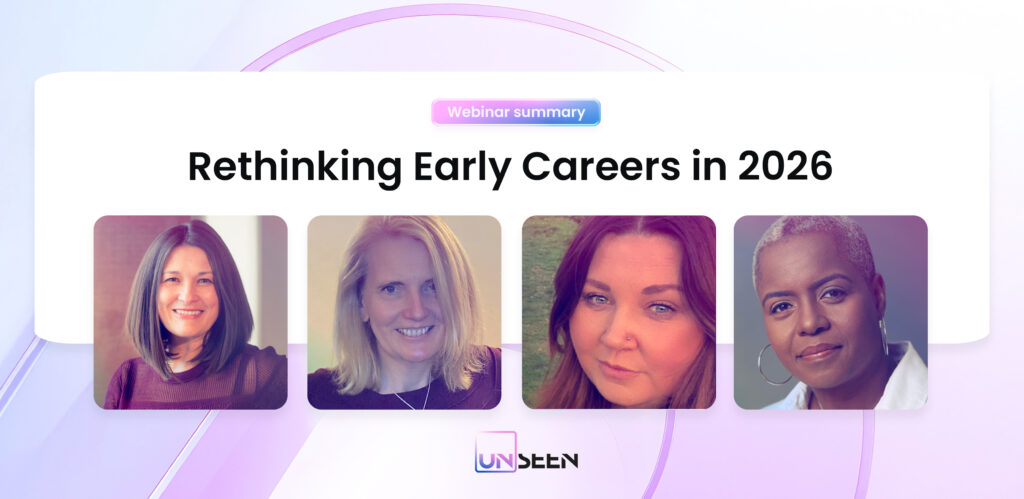
This article is a summary of a webinar discussion that took place on March 17 2026.
Titled Rethinking Early Careers: What needs to change in 2026, the webinar featured:
Ali Hackett, Director of Customer Experience at Unseen
Anne Marie Campion, Emerging Talent Specialist at Institute of Student Employers
Claire Monks, Graduate Programme Manager at NHS Wales
Dr Frances Trought, Founder of Everything D&I
The early careers market has always evolved, but this year feels materially different.
In our specialist early careers webinar, senior voices from across early careers, education and workforce strategy agreed that employers are now operating in a structurally different environment from just a year or two ago. 2026 is a year shaped by economic pressure, policy change, rising candidate anxiety, unprecedented application volumes and the accelerating impact of AI.
The result is a growing gap between how many organisations still recruit early talent and what candidates and businesses now need from those processes.
A more volatile market is changing how employers plan
One of the clearest themes from the discussion was that traditional annual planning cycles are becoming harder to sustain.
Rapid shifts in hiring demand, budget scrutiny, apprentice reform and wider economic uncertainty are making long-term talent planning less predictable than before. Our expert panel reflected that strategies which might once have remained stable for a year can now feel outdated within months.
That pressure is forcing employers to move beyond inherited recruitment cycles and towards more deliberate workforce planning: understanding which roles are likely to change, which skills will remain critical and where future pipelines genuinely need investment.
AI is no longer a side issue in early careers
The conversation confirmed that the debate has moved on from whether candidates should use AI, into accepting the reality that its use is prevalent.
Candidates are already using it, employers are using it, and trying to remove it from recruitment entirely is increasingly unrealistic.
The more important challenge now is how organisations respond fairly and intelligently.
This includes:
Deciding where AI use is acceptable in applications
Understanding how it affects assessment validity
Addressing unequal access to paid AI tools
Distinguishing between assisted responses and genuine judgement
Several speakers noted that many established selection methods are becoming less effective in this context. Generic written answers, CV screening and predictable competency questions are now easily generated or strengthened through AI.
The implication is not to remove rigour, but to redesign it, placing greater weight on judgement, authenticity and live interaction.
Related solution
Rethink assessment for a changing candidate landscape
As traditional screening methods become less effective, assessment needs to reflect how people think, solve problems and respond in real situations. Our Digital Assessment Centre platform, TopScore, helps employers assess potential more fairly and consistently.
A strong consensus emerged that assessment processes need to become more representative of how people will actually work.
If AI will be part of day-to-day working environments, then excluding it entirely from recruitment creates an artificial test.
Instead, employers should increasingly assess:
How candidates think
How they solve problems
How they apply judgement
How they use tools responsibly
That points towards more situational tasks, more project-based exercises and more live interaction, particularly later in the process.
At the same time, panellists acknowledged the practical tension this creates: face-to-face assessment and richer interaction often require more resource at a point when many teams are being asked to deliver more with less.
The confidence gap is now a major recruitment issue
One of the most important insights from the webinar was that candidate behaviour is being shaped not only by competition, but by confidence.
Across sectors, employers are seeing:
Higher anxiety
Lower certainty
Greater fear of rejection
Increased disengagement between offer and start date
For many young people, repeated rejection is no longer just part of the process but an experience that it is affecting confidence in education choices, career direction and whether they belong in professional environments at all.
That means candidate experience is no longer a secondary consideration. It has become central to conversion and retention.
Several speakers argued that employers need to think much more carefully about:
How rejection is handled
Where clarity is missing
How transparent entry requirements really are
Whether candidates understand what is expected of them
Even simple improvements in communication can materially change outcomes.
Related solution
Build confidence before day one
When candidates feel informed, connected and reassured, they are more likely to stay engaged throughout the journey. Unseen’s Candidate Experience & Onboarding platform, Meet & Engage, helps employers create stronger touchpoints before offer, after offer, and through onboarding.
Human connection matters more than ever before day one
A particularly strong theme was that organisations often underestimate how fragile the period between offer acceptance and start date has become.
This is where doubt grows, competing offers strengthen, and silent drop-off happens.
What prevents that is rarely process alone. It also about relationships and authenticity.
The most effective examples shared all involved stronger human contact:
Manager introductions
Buddy relationships
Early cohort engagement
Invitations to informal events
Clearer onboarding support
Practical visibility of what the first weeks will look like
As one panellist put it, organisations that retain talent best are often those that continue recruiting candidates emotionally right up until day one.
Skills-based thinking must go further
Another major point was that many organisations still talk about skills-based hiring more than they fully practise it.
Rigid academic filters, narrow qualification assumptions and institutional bias can still close off talent unnecessarily.
The panel challenged employers to think more carefully about aptitude, transferable capability and demonstrated potential – particularly where future roles are changing quickly anyway.
This matters not only for fairness, but for long-term talent resilience.
If organisations continue selecting only through familiar indicators, they risk reproducing the same talent profiles while missing the wider capabilities increasingly needed in a changing market.
Education and employers need closer alignment
A repeated concern was the widening disconnect between what education systems are producing and what employers expect.
Universities, schools and colleges are under pressure themselves, often being asked to support more students with fewer resources.
At the same time, employers continue to expect stronger work-readiness, AI fluency, data literacy and commercial understanding.
The discussion suggested that solving this cannot sit with one side alone. More partnership is needed:
Earlier exposure to employers
More meaningful insight experiences
Micro-internships and challenge-based learning
Stronger collaboration around future skill needs
The strongest examples are those that help young people understand work before formal application begins.
The strategic shift for employers
Taken together, the discussion pointed to a clear conclusion:
The organisations likely to succeed in early careers now will be those that stop treating recruitment as a fixed annual process and start treating it as a connected talent system – one that combines planning, assessment, communication, development and belonging.
The external pressures are unlikely to ease soon.
But many of the strongest responses are within employers’ control:
Simplify where complexity adds little value
Redesign outdated assessment steps
Build trust earlier
Communicate more clearly
Create stronger bridges between attraction and retention
In a market where candidates have more uncertainty and employers have less margin for error, the organisations that feel most human are often the ones that perform best.
Watch on demand
Hear the full discussion
This article captures some of the key themes from the conversation, but the full webinar explores the practical challenges, audience questions and panel perspectives in much greater depth.
The importance of a well designed selection process
A well-designed selection process improves hiring outcomes, strengthens your employer brand, and gives candidates a fair and consistent experience.
Many organisations still rely on processes that have simply grown over time rather than being deliberately designed. This means that interviews are unstructured, assessments feel disconnected, and decisions depend too heavily on individual judgement.
If you want better results, the process needs to be built with more intent. So, how can you go about designing a selection process that truly works for you?
Step 1
Start with a clear definition of success
Before even thinking about assessment methods, you need to decide on what ‘good’ looks like in the role you’re trying to fill.
That means identifying the capabilities, behaviours, and potential indicators that are genuinely linked to performance. Without that foundation, it’s difficult to assess candidates in a meaningful or consistent way.
Once defined, these criteria should inform every stage of the process. Whether you’re using interviews, job simulations or task-based assessments, each element should be tied back to those same measures of success.
Structured assessment design plays an important role here. It allows you to move away from instinct-led decisions and towards a more consistent and evidence-based approach.
Step 2
Design the process as a connected journey
Selection processes are often built in stages that don’t fully connect. Candidates repeat similar information in different formats, while hiring teams gather overlapping or incomplete insights.
A stronger approach is to treat the process as a single, joined-up journey.
Each stage should build on the previous one:
• Early stages can focus on core capabilities and potential
• Later stages can explore depth, judgement and real-world application
• Final decisions should draw on a complete and consistent set of evidence
This reduces duplication, improves efficiency, and gives hiring teams greater confidence in their decisions.
Assessment centres continue to play an important role here, particularly for roles where collaboration, communication and decision-making need to be observed in practice. Designed well, they allow organisations to see how candidates perform in realistic scenarios.
Step 3
Keep candidate experience practical and relevant
Candidate experience is shaped by clarity, relevance and respect for time. Processes that feel overly long, repetitive or unclear tend to lead to disengagement. In contrast, well-designed processes feel focused and purposeful.
A few principles make a noticeable difference:
• Clear instructions and expectations at every stage
• Assessment tasks that reflect real aspects of the role
• Consistency in how candidates are evaluated
• Communication that feels timely and considered
Employee-generated content can support this by giving candidates a more realistic understanding of the role and organisation. Seeing and hearing from employees helps set expectations and can make assessments feel more grounded in real work, replacing static or overly polished materials with something more representative of day-to-day experience.
Step 4
Build fairness into the design
Fairness needs to be considered upfront rather than reviewed after the fact.
Unstructured interviews, inconsistent scoring and unclear criteria all introduce bias. Over time, this affects both hiring quality and trust in the process.
A more structured approach helps to address this:
• Standardised assessment methods across candidates
• Clear scoring criteria linked to role requirements
• Interview frameworks that reduce subjectivity
• Documentation and data that support decision-making
Combining structured psychometric assessment with well-designed assessment centres allows organisations to build a more complete and balanced picture of each candidate, while maintaining consistency across the process.
Step 5
Bring it together
Designing a strong selection process comes down to clarity, structure and consistency.
That means being clear on what success looks like, building a process where each stage adds meaningful insight, and using the right tools to support fair and evidence-based decisions.
Used together, these approaches help create a selection process that is more predictive, more engaging, and more reliable.
Conclusion
If your current process feels inconsistent or overly dependent on individual judgement, it’s worth reviewing how it has been designed.
Small changes in structure and assessment approach can have a significant impact on both hiring outcomes and candidate experience.
Speak to an expert
Share your goals and challenges with our qualified team to discover how Unseen can help you to hire your way.
Welcome to our Psychometric Spotlight video with Peter Clarke, Head of Learning Performance and Innovation at St James’s Place.
Here you’ll discover how St James’s Place worked with Unseen and used the Evolve Assess platform with their Leadership Blueprint Framework to create accessible tools that have been used by the whole organisation.
Project Summary
The Unseen team built the digital assessment platform underpinning the St. James’s Place (SJP) Leadership Blueprint self-assessment.
This transformed SJP’s previously facilitator-led, resource-intensive leadership sessions into a scalable, online tool accessible across the entire FTSE 100 organisation.
Unseen also developed the Team Climate assessment, collaborating closely with the SJP team to refine ideas, challenge assumptions, propose innovations, and enabling any team to measure unity, rhythm, and spirit without requiring a facilitator. Unseen ensured the tool was inclusive and relevant to all roles and levels, not limited to senior leadership.
“What the [Unseen] guys did really, really well is that high touch, high design approach something that looked and felt really effective for us.”
Peter Clarke Head of Learning Performance and Innovation at St. James’s Place
Key Outcomes & Results
The Evolve Assess platform delivered both high-touch design and robust technical functionality, creating a tool that felt modern, intuitive, and high-quality, an element repeatedly praised by St. James’s Place.
Successful launch of the St. James’s Place Leadership Blueprint across the business provided employees with clear insight into their current leadership behaviour and areas for stretch or development, with rapid adoption across the whole breadth and depth of the organisation, including very senior leaders.
This resulted in a markedly improved employee experience: visually polished, intuitive, engaging, and reflective of SJP’s modern learning strategy.
The Team Climate assessment now enables teams to self-diagnose and drive their own development, unlocking organisational reach that was previously impossible, and the platform now supports next-phase evolution.
Host assessments your way
Book a demo today and say goodbye to clunky, off-the-shelf platforms.
Creating a bespoke development centre for Sir Robert McAlpine
Sir Robert McAlpine, one of the UK’s leading construction firms, partnered with Unseen’s assessment specialists, Sten10, to identify and select the first cohort of participants for their Future Leaders Programme, delivered in association with Cranfield University.
About the Customer
Organisation
Sir Robert McAlpine
Industry
Construction & civil engineering
Use Case
Development centre for identification and selection of participants for their Future Leaders Programme
Improving outcomes
Through the design of realistic, relevant, and engaging exercises
Background
Sir Robert McAlpine (SRM) needed a fair and objective process to select participants for the first cohort of their Future Leaders Programme.
The Challenge
Ensuring fairness:
The process had to be inclusive, avoiding any bias towards construction-specific
experience.
Aligning with real demands:
Selected individuals needed the resilience, leadership ability and commitment to make the most of the challenging programme at Cranfield and succeed in future senior roles.
Engaging busy professionals:
The assessment process had to be rigorous without being overwhelming. It needed to be engaging enough to motivate high-potential candidates to apply and
participate fully.
The Solution
Sten10 designed a tailored Development Centre (DC) based on SRM’s
leadership competency framework, enhanced with input from Cranfield
University. The exercises, built around a fictional failing project, were
designed to measure behaviours such as problem-solving, collaboration,
and resilience. Participants took part in group tasks, presentations and
interviews, with clear assessment criteria and trained observers to ensure
consistency and fairness.
Design
Designing realistic, relevant, and engaging exercises
Comms
Creating communication materials and a smooth application process
Training
Training assessors to minimise bias and focus on objective behavioural evidence
Logistics
Managing the logistics of running multiple, seamless development centres
Integration
Facilitating fair integration sessions for selection of final candidates
“A great experience, Sten10 understood our need and put forward practical solutions in a quick timeframe.”
The Impact
Quality
The Development Centre enabled SRM to identify individuals with genuine leadership potential, not just those who were confident or well-known internally.
Cranfield University reported the SRM participants were particularly well-suited
and well-prepared for the programme.
All participants remained engaged and committed throughout the programme;
underlining the effectiveness of the selection process.
Efficiency
The process was designed and delivered with precision. A clear assessment matrix, structured integration sessions, and observer training ensured reliable, evidence-based decision-making. Sten10’s attention to logistics meant the development centres ran smoothly and without disruption.
SRM benefitted from a streamlined selection process that saved time while
maintaining high standards.
Engagement
Candidates were motivated by the opportunity and felt supported throughout, thanks to clear application materials and a welcoming information pack. Even those not selected for the programme received personalised feedback, reinforcing SRM’s commitment to development.
“I believe the process that Sten10 ran was successful in preparing the applicants, but also in selecting the right applicants.”
Let’s build potential, together
Share your goals and challenges with our qualified team of assessment experts today.
Welcome to our Psychometric Spotlight video with Juliette Alban-Metcalfe, the Chief Executive of Real World Group.
Here you’ll discover how Real Wold Group created their self-assessment, the Real World Leader, using Unseen’s psychometric testing platform, Evolve Assess.
Project Summary
Unseen partnered with Real World Group (RWG) to develop and validate the Real World Leader assessment, a senior-level leadership psychometric. RWG also brought in Unseen’s specialist experts in ipsative psychometric design, Sten10, to help convert years of engaging-leadership research into a robust self-assessment tool suitable for selection and coaching.
Unseen supported question design, tool structure, measurement approach, and psychometric robustness, assisting through an iterative, multi-year research and validation process involving large-scale data collection, analysis, and re-analysis, all ensuring the assessment:
• accurately measured leadership behaviour rather than personality
• worked effectively for senior and executive-level selection and development
• met evidence-based and scientific standards for leadership assessment
“They [Unseen] are very much experts in helping to create ipsative psychometric tools.”
Key Outcomes & Results
The Evolve Assess platform allowed for a successful launch of The Real World Leader, now used by organisations across industries for executive selection and leadership coaching. The tool is recognised as distinctive in the market for its focus on behavioural leadership indicators, not personality traits. There was a strong practitioner reception — especially among coaches — who value the tool’s ability to create richer development conversations than personality-based psychometrics.
Unseen also improved Real World Group’s ability to:
• Select the right leaders at senior/executive levels.
• Develop leaders using a scientifically grounded, behaviour-based framework.
• Increase diversity and inclusion by levelling the playing field, avoiding outdated criteria, and assessing behaviours proven to support inclusive leadership.
Demand has since grown for additional versions (middle-manager, junior-manager, and non-executive versions), showing clear market validation and client confidence in the tool.
Host assessments your way
Book a demo today and say goodbye to clunky, off-the-shelf platforms.
Rethinking Early Careers: What Needs to Change in 2026
Join Ali Hackett, Unseen’s Customer Experience Director, along with Anne Marie Campion, Emerging Talent Specialist at the Institute of Student Employers, and Dr. Frances Trought, DEI expert, in this forward-looking session.
Together, they’ll be sharing what they’re seeing across the Early Careers market, and what needs to change.
Watch on demand
Enter your details to access the recording.
The topics we’ll be covering:
What feels different about this year’s early careers cycle
Dive deeper into how the early careers landscape is being affected by work readiness challenges, skills gaps and early attrition.
How attraction, engagement, assessment, and selection should evolve
Learn how employers can balance
efficiency with candidate experience
as expectations shift and AI evolves.
Where organisations risk losing talent
Find out how you can strengthen engagement and work readiness between offer and start date, as we share advice on designing a more connected and resilient early careers strategy.
Materials you will receive
A concise post-session summary with key takeaways
On-demand access to the webinar recording
Meet the speakers
Ali Hackett
Customer Experience Director, Unseen
Anne Marie Campion
Emerging Talent Specialist, Institute of Student Employers
Having worked within customer-focused roles for over eight years, alongside experience as a recruiter and assessor prior to joining Unseen, I understand the pain points our clients face and do everything I can to help assessments run as smoothly as possible.
Putting customers first
To me, great customer service means being a trusted advisor; providing fast and detailed responses to queries, while continually improving processes based on my experiences working with hundreds of clients.
Making technology feel simple
One of the most rewarding parts of my role is seeing clients transform from feeling apprehensive about using new technology to becoming confident, self-sufficient experts and genuine advocates of the platform.
Taking pride in my team
I’m incredibly proud of our team’s outstanding customer retention rate and how we’ve strengthened collaboration across the wider Unseen group. By introducing clients to a broader range of platforms and services, we’re able to solve more recruitment and assessment challenges while building stronger, more strategic partnerships.
“Great customer success isn’t just about answering questions. It’s about building trust, creating confidence and helping every client achieve more than they thought possible.”
Demo our solutions
Chat to our team to learn more about the solutions they can help you with.
I’ve worked within customer-focused roles for a number of years, with a strong focus on client relationship management within SaaS businesses.
Supporting our clients
I genuinely care about delivering a positive experience for clients and making sure they feel supported and listened to.
Highlights of the role
One of the biggest highlights of my role at Evolve Assess has been being involved in large-scale assessment and 360 projects, where no two client requirements are ever the same.
“I want to continue helping clients get the most value from our platform and services, delivering a consistent, high-quality experience that builds long-term trust and partnership with our clients.”
Demo our solutions
Chat to our team to learn more about the solutions they can help you with.