Category: Resources

  • Report download: The Science of Assessment Centres

    Report download: The Science of Assessment Centres

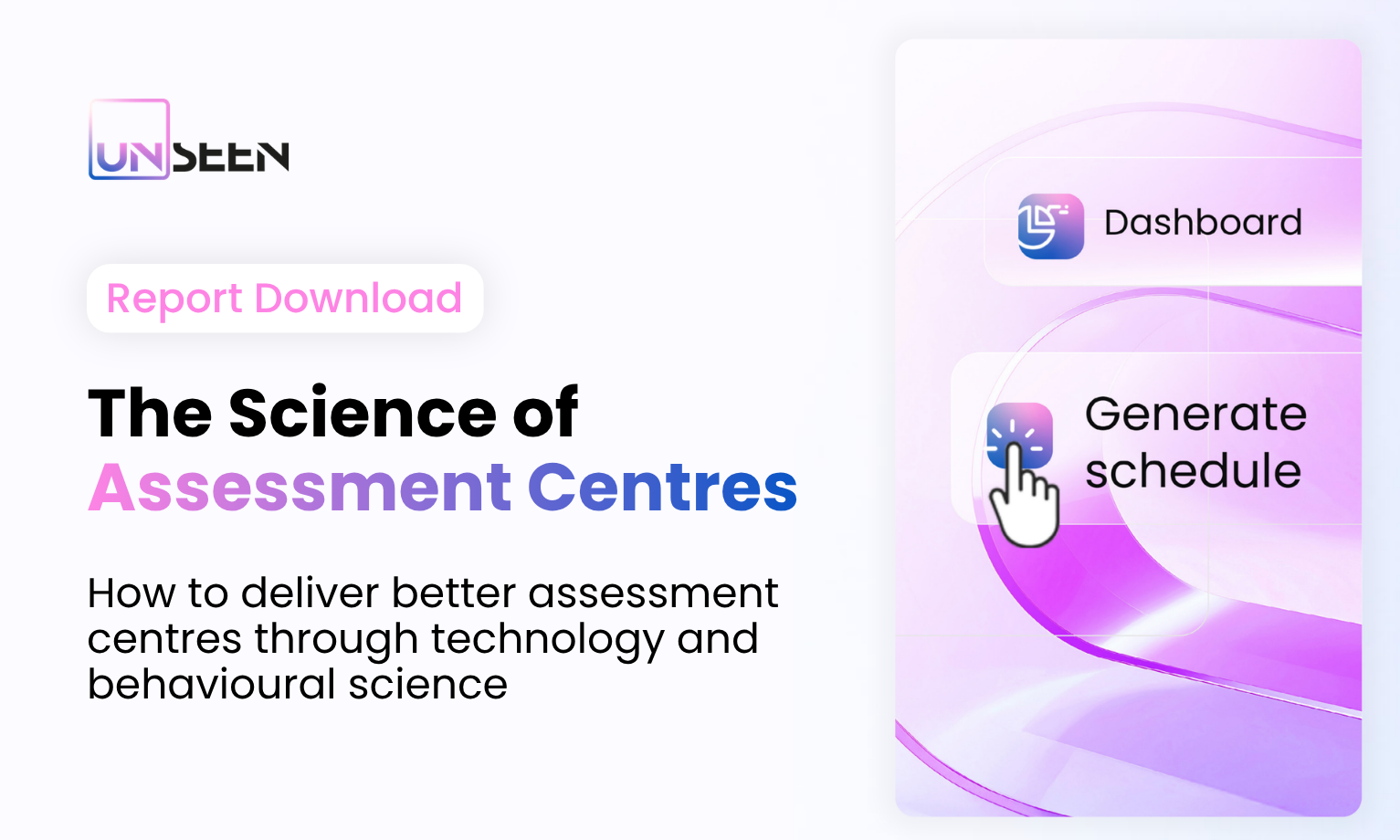
    The Science of Assessment Centres
    Part of Unseen’s ‘The Science of…’ series

    The Science of Assessment Centres

    How to deliver better assessment centres through technology and behavioural science.

    Free download

    Get instant access

    Fill in your details to download the full report.

    What’s inside

    Three things the report covers

    Assessment centres influence some of the most important decisions organisations make — who they hire, promote and invest in.

    Learn how, by combining evidence-based assessment principles with behavioural science insights, you can create assessment experiences that are more engaging for candidates, more manageable for assessors, more scalable for organisations, and more defensible from a fairness and validity perspective.

    01

    How behavioural science shapes assessment centre quality, and what that means in practice

    02

    Key principles from behavioural science you can apply to how your assessment centres are designed and run

    03

    The tools you can use to give your assessments psychological defensibility

    The best assessment centres draw on both occupational psychology and behavioural science.

    Ben Williams, Chief Scientist, Unseen Group

    Read the full report

    Discover how to deliver better assessment centres through technology and behavioural science.
    Download free ↑
  • Report Download: On their wavelength

    Report Download: On their wavelength

    On Their Wavelength — Unseen Group
    Emerging Talent Report 2026

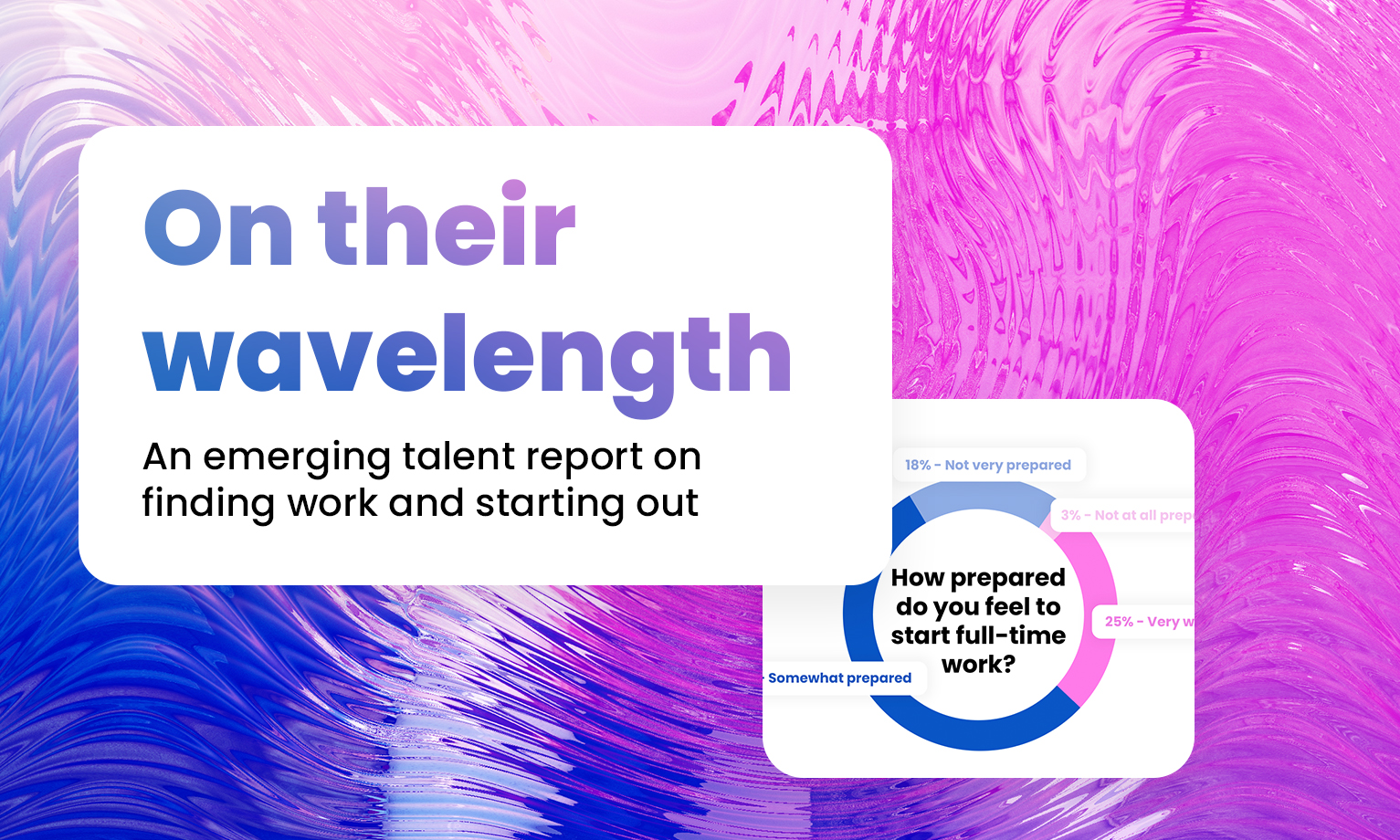
    On Their Wavelength

    An emerging talent report on finding work and starting out. Throughout Spring 2026 we surveyed 818 students, graduates and apprentices across the UK to understand how they experience the early careers market, the barriers they face, and how ready they feel for work.

    818
    Respondents across the UK
    Free download

    Get instant access

    Fill in your details to download the full report.

    What’s inside

    Three things the report covers

    We asked candidates about the skills they bring, the barriers they face, and what “work readiness” means to them in practice, to highlight where expectations and reality aren’t quite aligning and what employers can do to have the greatest impact.

    01

    How students, graduates and apprentices navigate the early careers market — from application to offer.

    02

    The confidence gap, the barriers they face, and what “work readiness” actually means to them in practice.

    03

    What employers can do to help candidates feel prepared, confident and able to contribute from day one.

    Key findings

    The numbers that matter to early careers teams

    A handful of findings that point to something more systemic than a skills gap.

    Finding 01

    65%

    of candidates say live interviews feel the fairest way to demonstrate their strengths, yet 41% find them the most difficult stage. They want to explain themselves in their own words, and the process often makes that harder than it needs to be.

    Finding 02

    72%

    say feedback is the single thing that would most improve their confidence during a recruitment process. Most receive none at all.

    Finding 03

    67%

    have stopped an application because it felt too long or too difficult, most commonly because there were too many stages or it was too time-consuming.

    Finding 04

    1 in 5

    people already in their first role said it took longer than six months to feel fully settled and productive. Candidates consistently underestimate how long that transition takes.

    What employers can act on

    Where the real gaps are

    Recruitment process

    Transparency builds candidate confidence

    74% of candidates didn’t fully understand what employers were looking for throughout recruitment and assessment. Clearer communication about what’s being assessed and why reduces anxiety and improves the quality of what candidates actually show you.

    52% said a clearer explanation of what’s being assessed would improve their confidence
    41% said the opportunity to do a practice run would help
    28% wanted to understand how assessment results were actually used
    Transition to work

    The gap between starting and feeling settled is wider than employers tend to assume

    Imposter syndrome and unclear expectations were the top concerns for candidates both before and after starting work. The anxiety is rarely about capability. It is about not knowing what good looks like, or whether they will be supported enough to get there.

    60% cited lack of confidence or imposter feelings as their biggest challenge when starting work
    “Day in the life” content was the most requested form of pre-joining support
    Between 23% and 29% of candidates said they had hardly any understanding of what their first weeks would involve
    Work readiness

    Candidates define readiness through mindset and clarity, not just technical skill

    Across more than 380 open responses, candidates described work readiness in terms of confidence, adaptability and a willingness to learn. They don’t expect to know everything from day one. What they want is a clear sense of what’s expected and enough psychological safety to ask questions and grow into the role.

    Candidates most commonly asked: “What exactly will I do?” and “How will I be supported?”
    Mentoring, buddy schemes and structured onboarding were the most frequently requested forms of early support
    Those already in work were far more likely to say they’d have valued networking and culture support before starting

    The organisations that gain competitive advantage in early careers hiring are unlikely to be those that simply assess candidates more aggressively. They will be the ones that identify potential earlier, reduce unnecessary friction, and accelerate confidence, belonging and contribution once people arrive.

    Ben Williams, Chief Scientist, Unseen Group

    Read the full report

    818 candidates surveyed across the UK. Three sections covering the job market, the transition to work, and what readiness actually means to the people going through it.

    Download free ↑
  • Report | AI as a competency and the Intent Deficit

    Report | AI as a competency and the Intent Deficit

    AI in early careers — Roundtable Summary + Survey | Unseen Group × Cohesion
    Download

    AI as a competency and the Intent Deficit

    Get the combined Roundtable Summary + Survey. Learn a simple way to assess GenAI skills while keeping the hiring journey fair, and learn how to separate real interest from AI polished applications.

    Why this matters

    Expect AI use, then assess judgement

    Shift from detection to assessment. Focus on observable behaviours across tool choice, accuracy checks, data care, and honest reflection. Keep the process fair and coachable.

    The intent deficit

    Volume rises when AI speeds applications. Add short proof of effort tasks to surface genuine interest.

    AI as a competency

    Score prompting, evaluation, ethics and data care, and reflective practice with a simple rubric.

    Human at the end

    Be explicit about tool use across stages and keep people in the final decision to build trust.

    What is inside

    Roundtable Summary + Survey in one download

    • Survey insights on AI usage, expectations, and application behaviour
    • Signals that indicate genuine intent at apply and screen
    • GenAI Skills Framework with example tasks and scoring tips
    • Guidance on fairness, transparency, and inclusion
    • A 90 day rollout plan you can run this cycle
    Report cover preview
    Who it helps

    Built for early careers teams and partners

    Apply stage

    Introduce a five to eight minute micro task that checks understanding and effort without heavy friction.

    Interview

    Probe how AI shaped the work. Score the judgement, not the tool. Reward clear disclosure.

    Assessment centres

    Score outputs and reflections separately so honesty and critical thinking are visible.

  • Free Whitepaper: Tech-enabled, human centred – optimising your emerging talent journey

    Free Whitepaper: Tech-enabled, human centred – optimising your emerging talent journey

    Behind every emerging talent application is a future leader. But in a world of mass applications, automation, and limited recruiter time, how do you make each candidate feel seen, valued, and inspired to join you?

    This exclusive whitepaper by Meet & Engage brings together leading voices from HSBC, Grant Thornton, Costain and Teesside University, along with expert opinions from around the Unseen Group, sharing evidence-based strategies to help you:

    • Deliver high‑volume hiring without sacrificing quality
    • Build psychologically safe processes that reduce stress and disengagement
    • Use technology to scale fairness and efficiency while preserving the human touch
    • Forge powerful employer‑university partnerships for future‑ready talent
    • Create early careers journeys that leave candidates feeling valued and engaged

    Whether you’re running a graduate scheme, scaling apprenticeships, or reimagining onboarding, this whitepaper provides practical frameworks, case studies, and actionable takeaways to help you stay ahead.