Tag: ben williams

  • Blog: AI Orientation: webinar recap

    Blog: AI Orientation: webinar recap

    AI Orientation in practice: a recap of our webinar

    AI capability describes what someone knows and can do with AI today. It can be important when a role requires a particular skill from day one, but platform-specific measures may not transfer to other tools, and tests of technical skills can date quickly as technology changes.

    AI Orientation offers a broader view. The webinar introduced three related areas:

  • Dispositions and personality: ways of thinking, feeling and behaving.
  • AI-specific motivation and confidence: whether someone sees value in learning, feels able to do so and is willing to invest effort.
  • Attitudes, values and beliefs: what someone trusts about AI, how they view its consequences and which uses they consider acceptable.
  • These areas can help explain why people with similar skills may respond differently to new AI tasks. What they do not do is point to one ideal AI profile, instead, the role should determine which aspects matter.

    Ben then outlined how employers can put AI Orientation into practice: start with job analysis, establish the capabilities needed on entry, identify which aspects of AI Orientation matter for the role, and choose suitable ways to assess them.

    Our latest whitepaper, Beyond AI Literacy: A psychological analysis of why assessing for today’s AI skills is no longer enough, explores this process in more detail, including how existing assessments can be used and where structured interviews or realistic exercises may help.

    Three questions from the discussion

    How can an organisation assess AI Orientation when they have hundreds of roles?

    Ben’s answer was to balance consistency with enough detail to reflect the work:

  • Look for clusters of roles and the requirements they share.
  • Apply more detail where AI use has different or more significant implications.
  • Avoid both a bespoke assessment for every role and treating every role as identical.
  • This is a pragmatic way to decide what can be assessed consistently and where a role needs closer attention, rather than a fixed formula for grouping jobs.

    Can AI Orientation develop after someone is hired?

    One employer asked about development over time and specifically what to do when employee attitudes change, for example if they become more cynical about AI. Ben noted that the right response depends on the organisation and why attitudes have changed. There is no single intervention that will shift every team’s views.

    Personality tends to be more stable, while confidence, motivation and ethical views can change with experience and context. Development conversations can explore what is behind a person’s response. For example, someone who doubts they can learn a new tool might reflect on a time they successfully learned new technology. Someone who sees little value in AI, or objects to a particular use, needs a different discussion.

    What if a candidate objects to AI in selection?

    Ben shared a recent story from an event where a panel of students said they might react negatively to AI in recruitment, including on environmental grounds. Other candidates may welcome AI in selection because they expect a quicker process or believe it could reduce bias.

    Employers should understand whether the concern is about the selection method, a particular tool or AI use in the job, then assess candidates against the actual role requirements using consistent evidence.

    Watch the webinar recording to find out more about AI Orientation
  • Whitepaper: Beyond AI Literacy

    Whitepaper: Beyond AI Literacy

    New whitepaper

    Beyond AI Literacy

    A psychological analysis of why assessing for today’s AI skills is no longer enough

    In a short space of time, the concept of being “good at AI” has changed significantly as the tools have rapidly evolved. For employers, building assessments to understand candidate AI proficiency can therefore feel like chasing a moving target. How can we effectively evidence the skills we need from candidates when the tools are changing so quickly?

    Our latest whitepaper by Ben Williams, Chief Scientist at Unseen, introduces the concept of AI Orientation: a more enduring way to explore the motivations, confidence, values and beliefs that shape how people engage with AI; and how to turn those findings into useful assessment evidence.

    Get the whitepaper
    The idea

    AI literacy can only show so much

    Knowing what someone can do with AI today does not tell you everything about how they will approach tomorrow’s possibilities. AI Orientation considers the attitudes, motivations and personal boundaries behind that approach which allow us to understand a longer-term view of the individual.

    01 / PSYCHOLOGY

    The psychology behind AI use

    Our research-informed approach brings together three perspectives that offer a richer picture than asking whether someone is “good with AI”; personality, motivation and beliefs & attitudes.

    02 / PERSONALITY

    What you’re already assessing

    We explore how your existing assessments may already be providing the right kinds of evidence about some of the psychological foundations of AI Orientation.

    03 / APPLICATION

    Applying the approach

    The whitepaper looks at how you can apply job analysis to AI-enabled work, the legal considerations and how this can be relevantly applied to selection criteria.

    An example from the whitepaper

    Understand why people approach AI differently

    People with similar AI skills may need different support. AI Orientation explores the dispositions, motivations, attitudes, values and beliefs behind their approach. Open a statement to see how this could shape a development conversation.

    “I don’t think I can learn this.”
    Confidence in learning

    Willingness and self-belief are not the same.

    Someone may want to use AI but doubt their ability to learn. A supported, manageable task could be more useful than asking for greater enthusiasm.

    A useful starting point: what feels difficult, and what have previous learning experiences shown?

    “I can’t see the point.”
    Motivation for AI

    Find the purpose, not just the enthusiasm.

    Someone does not have to find AI fascinating to have a reason to use it. Explore whether an appropriate application could help them achieve an outcome they value.

    A useful starting point: what real problem could AI help with, and what would the trade-offs be?

    “I disagree with how it is used.”
    Values and beliefs

    A concern is not automatically a development need.

    An objection might relate to one application, a supplier or a settled ethical principle. Understand its scope before assuming that more training will change it.

    A useful starting point: which uses feel unacceptable, and would any safeguards address that concern?

    Illustrative development conversations from Beyond AI Literacy. These are starting points for discussion, not an assessment or a diagnosis.

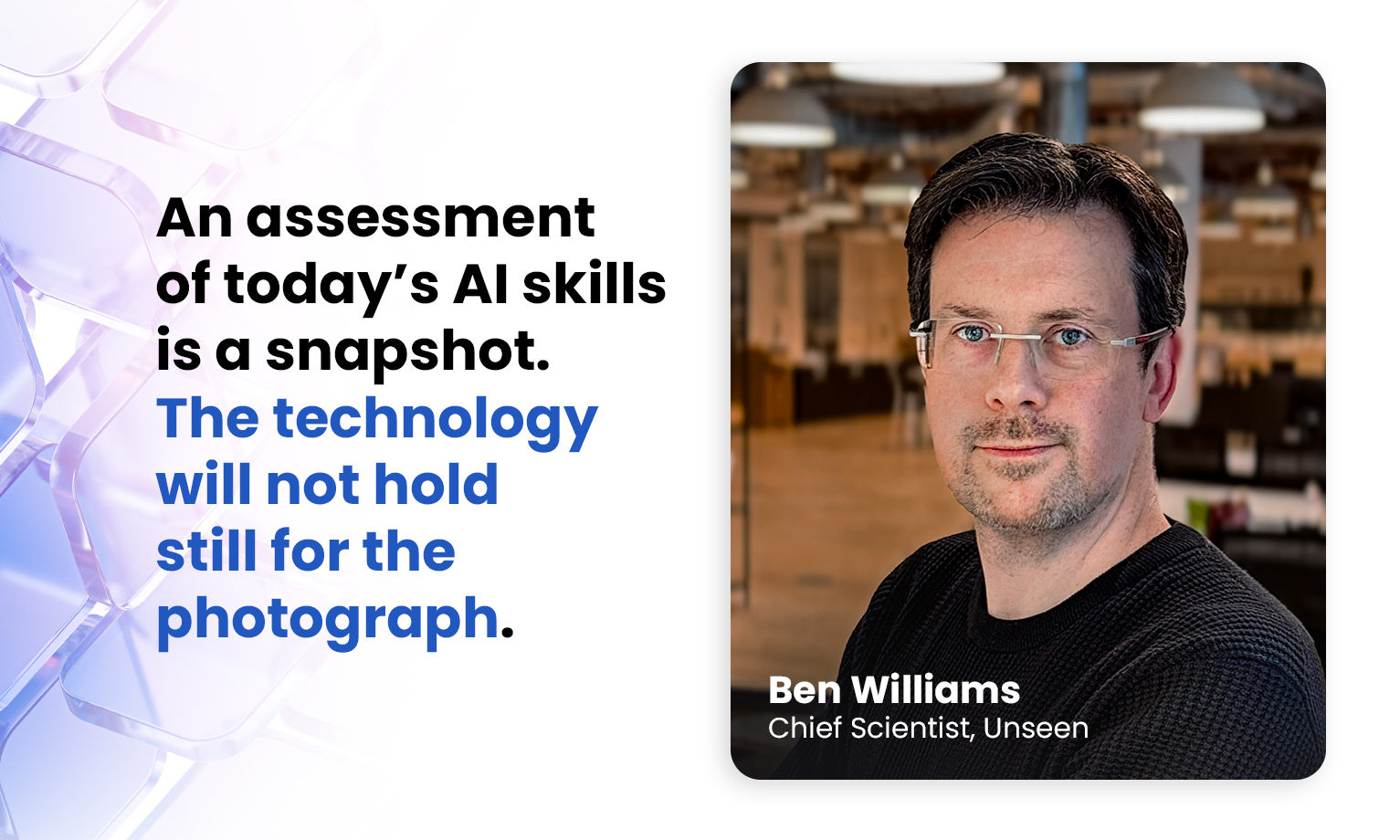
    Ben Williams with a key quote from Unseen’s Beyond AI Literacy whitepaper
    Inside the whitepaper

    A more considered way to understand AI skills

    Beyond AI Literacy explores how AI Orientation can inform conversations about hiring and development, while keeping assessment connected to what a role actually requires.

    • Look beyond current technical skills to the motivations and beliefs that shape AI use.
    • Consider how existing assessments can be complemented by structured interviews and tailored exercises.
    • Use a more personal starting point for development conversations about AI.

    Explore what sits beyond AI literacy

    Get the whitepaper