How to drive authenticity & connection with employee-generated content
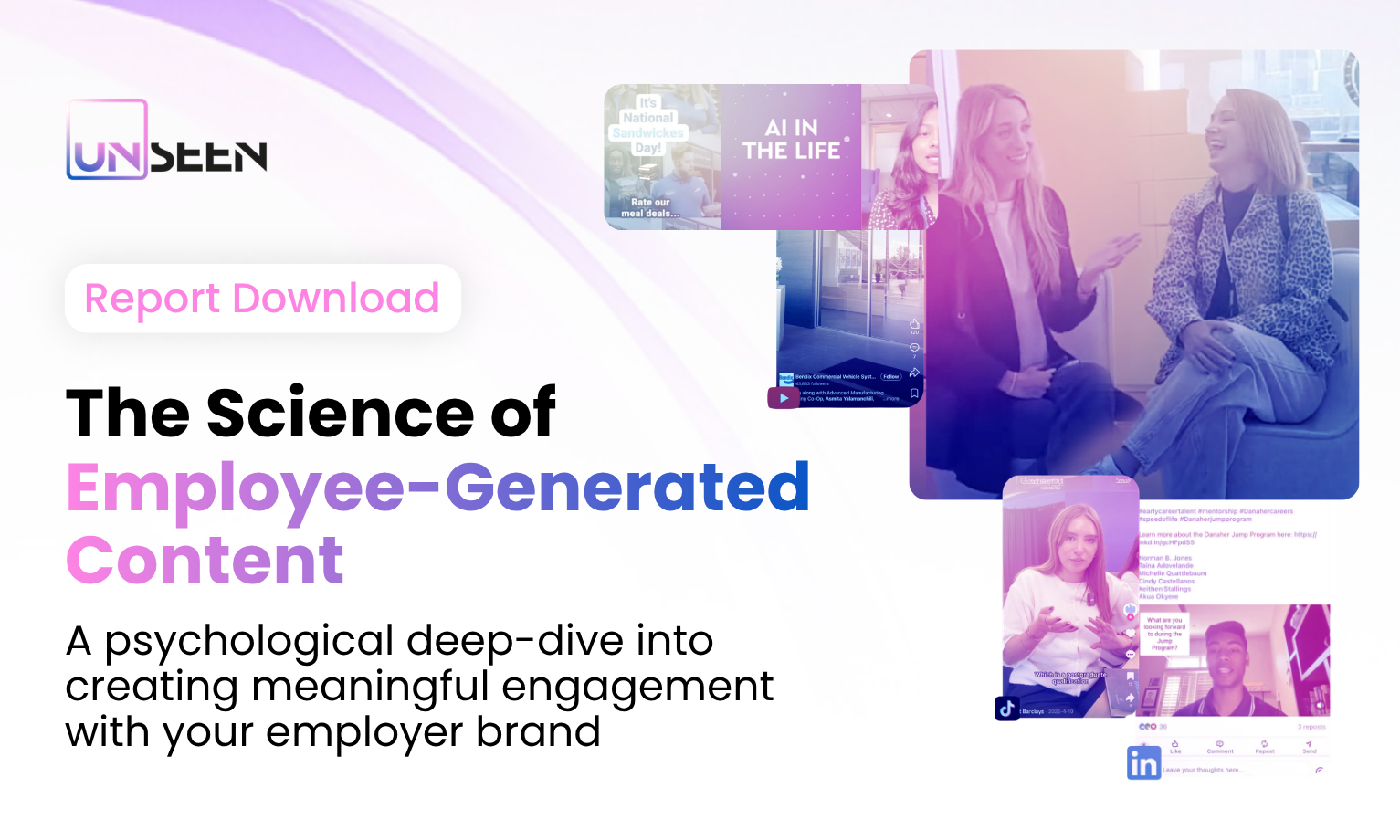
A psychological deep-dive into creating meaningful engagement with your employer brand
Organisations spend considerable time thinking about what they want candidates and employees to hear. But who communicates a message, how it is expressed and whose voices are represented can be just as important as the message itself.
This report, part of Unseen’s The Science of… series, brings together nine psychological principles surrounding the contributor and the audience. It offers a framework for understanding why the human experiences that employee-generated content makes visible truly matter, and how to put those principles into practice.

The Virtuous Circle of Employee Content
At its simplest, employee-generated content involves two people: someone being asked to share an experience (the contributor), and someone else being asked to make sense of what they see and hear (the audience). The two sets of principles are connected: How participation is designed influences whose voices are heard. The voices that are heard shape what audiences trust, connect with, and learn from.
The paper explores how the psychology of the contributor and the psychology of the audience work together, and how to apply each principle when designing an employee content project.
The psychology of the contributor
Four principles address the contributor’s questions: Can I do this? Do I understand what I’m being asked to do? Can I do this in a way that works for me? Is it normal and acceptable for someone like me to take part?
The psychology of the audience
Five principles address the audience’s questions: Do I believe this? Do I connect with this? Can I see myself here? Is this actually right for me? Do people who work here appear to believe this too?
Putting the science into practice
The paper shows how to apply each principle when designing contribution projects, and how Unseen’s Seenit platform can support capture, editing and distribution of employee-generated video.
“I believe people trust people, not brands.”
Small changes in the way you ask can make a big difference
Whether people contribute, and whether audiences believe what they hear, depends on how the request is framed and who is invited to speak. Open an example to see how the principle applies in practice.
“I don’t think I’ll be any good at it.”
Willingness and capability are different problems.
The barrier is not always “I don’t want to contribute”. Sometimes it is a belief that the contribution will not be good enough. Appropriate guidance, examples and support can strengthen confidence without taking the contributor’s voice away from them.
A useful starting point: give people an achievable first contribution and enough support to think, “I have something worth saying, and I can do this.”
“We provide extensive support to employees experiencing significant life events.”
Experience is more credible than endorsement.
An employee describing the support they actually received gives the statement evidence. Authenticity is an outcome of the process, not a production style, so production should support the employee’s voice rather than replace it.
A useful starting point: ask “What is something about working here that you didn’t expect before you joined?” rather than “Tell us why this is a great place to work.”
Illustrative examples drawn from The Science of Employee-Generated Content.
Turn employee voices into content that drives hiring and culture
Explore how technology and behavioural science can support employee storytelling, from hiring to engagement.