

Author: Jess Wood

  • Case Study: Transforming Early Careers Assessment at Scale for EDF

    Case Study: Transforming Early Careers Assessment at Scale for EDF

    Client logo
    TopScore logo
    Utilities & Energy

    Transforming Early Careers Assessment at Scale for EDF

    EDF is one of the UK’s largest energy providers, recruiting hundreds of early careers candidates each year across graduate schemes, apprenticeships and industrial placements.

    What began as a solution to enable recruitment during COVID has evolved into a long-term strategic platform that underpins assessment centre delivery across EDF’s national early careers programmes.

    About the Customer

    Organisation

    EDF

    Industry

    Utilities & Energy

    Use Case

    Assessing large candidate volumes across multiple programmes

    Scale

    700+ candidates attended assessment centres in 2025 alone

    The Challenge

    When face-to-face assessment centres became impossible during the pandemic, EDF needed a way to continue recruiting at scale without compromising candidate experience, assessment quality or hiring outcomes.

    EDF needed a solution that could:

    – Assess large candidate volumes across multiple programmes
    – Reduce administrative burden and logistical complexity
    – Improve recruitment speed and flexibility
    – Support sustainability goals by reducing travel and paper usage
    – Deliver a positive and consistent candidate experience

    Traditional assessment centres required significant coordination, including venue management, travel arrangements, printed materials and manual scheduling, creating challenges when candidates or assessors changed plans at short notice.

    “We didn’t stop recruiting during COVID, however the environment and our commitment to our Zero Harm safety culture meant face-to-face assessments we not a viable option.”

    The Solution

    EDF implemented TopScore across its Graduate, Apprenticeship and Industrial Placement programmes, creating a central hub for assessment centre delivery and coordination.

    Today, the platform supports approximately 50 assessment centres annually, with up to five centres running per week during peak recruitment periods.

    Impact

    Significant Cost Savings

    Moving away from venue-based assessment centres has substantially reduced operational costs associated with travel, facilities and administration.

    EDF estimates an overall cost reduction of almost 80% compared with traditional assessment centre delivery.

    Flexibility & Reliability

    TopScore has reduced scheduling complexity and made it easier to adapt assessment centres in real time.

    “Using TopScore, we can change timetables at the drop of a hat.”

    EDF also reports exceptional platform reliability.

    “We’ve never had technical difficulties, never had an issue.”

    Enhanced Candidate Experience

    Candidate experience remains a key priority for EDF. Every application is reviewed by a person, ensuring candidates are not excluded through automated screening alone.

    “The point of Early Careers is to nourish talent – we don’t want to lose candidates through an automated AI process with no human interaction.”

    Candidate feedback consistently highlights the platform’s ease of use, clear navigation and smooth assessment experience.

    Sustainability Impact

    Supporting EDF’s sustainability ambitions has been a major benefit of the platform.

    TopScore has enabled:

    – Significant reductions in candidate and assessor travel
    – Fully paperless assessment delivery
    – Elimination of printed assessment materials
    – Reduced environmental impact from assessment centre operations

    “Sustainability is really important to us at EDF.”

    Long-Term Impact

    More than five years after implementation, TopScore remains a core part of EDF’s early careers recruitment strategy.

    The platform continues to support scalable hiring, operational efficiency, improved candidate experiences and sustainability objectives, demonstrating how a solution introduced during a period of disruption became a long-term strategic advantage.

    Key Results

    TopScore has enabled EDF to manage high recruitment volumes more efficiently while maintaining assessment quality.

    In 2025 alone:

    23,000 applications received

    716 candidates attended assessment centres

    192 offers accepted

    EDF estimates that virtual assessment centres save candidates approximately five hours of travel time per person, while enabling recruitment teams to assess more candidates in a shorter timeframe.

    “We can assess 25 candidates over a day much more easily now.”

    Demo TopScore’s full range of features

    Chat to our team to book your bespoke demo of Unseen’s digital assessment centre platform, TopScore.
    Test its full range of features and see how it can streamline your assessment centres.
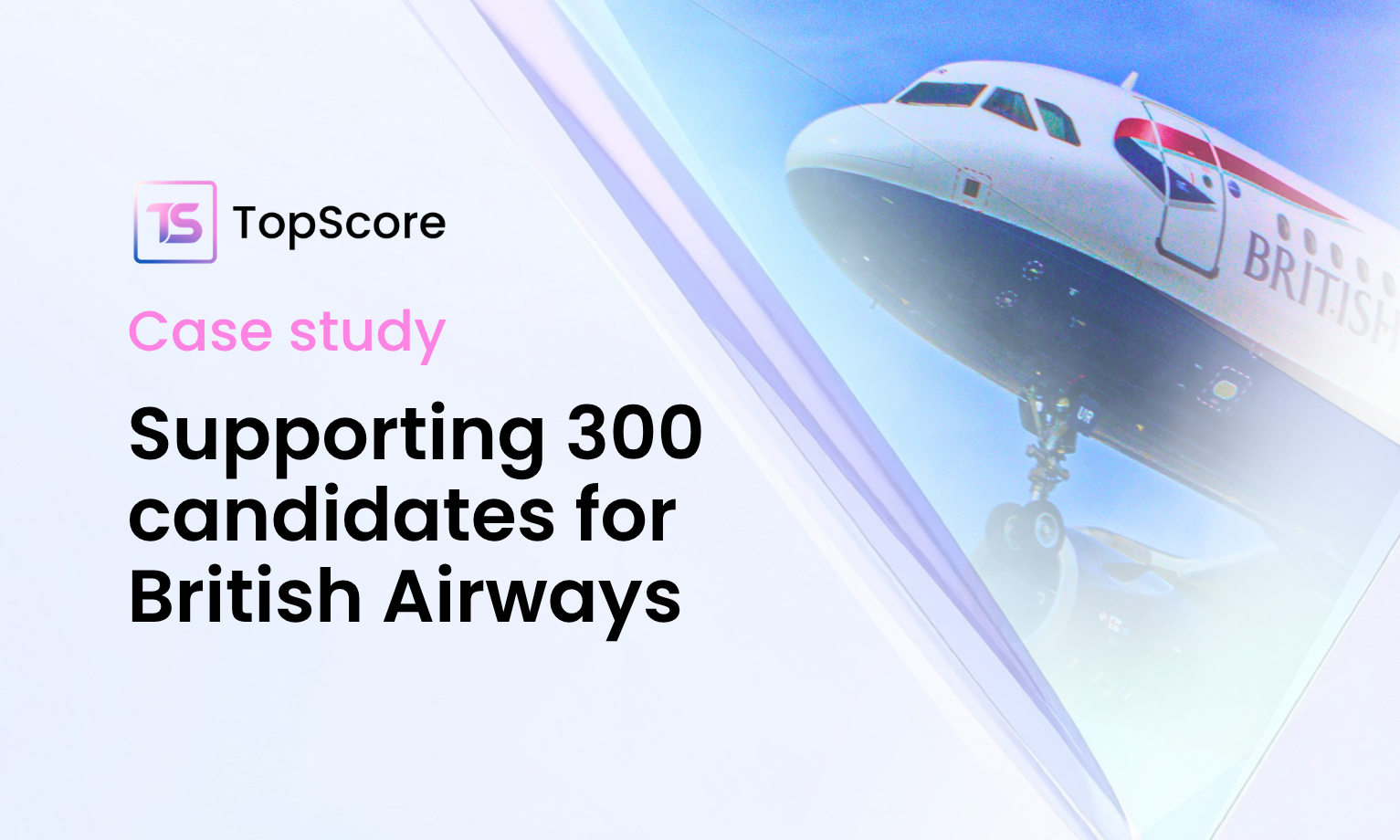
  • Case Study: How British Airways supported 300 candidates with TopScore

    Case Study: How British Airways supported 300 candidates with TopScore

    How British Airways supported 300 candidates with TopScore

    About the Customer

    Organisation

    British Airways is the United Kingdom’s flag-carrier airline and the largest UK-based carrier by international fleet and destination size.

    Focus Area

    The organisation recruits a significant volume of emerging talent each year across graduate, apprenticeship, engineering, head office, customer operations and regional programmes.

    300

    candidates supported this year alone

    50%

    reduction in assessor time

    20-35

    assessment days annually

    The Challenge

    Prior to implementing TopScore, British Airways relied on a combination of Microsoft Teams, breakout rooms and spreadsheets to manage virtual assessment centres. While functional, the process was highly manual, time-consuming and difficult to scale. Assessors had to manage multiple systems simultaneously, creating additional administration and operational complexity.

    As assessment activity increased following the pandemic, the team recognised the need for a more streamlined, professional and scalable solution that could improve both operational efficiency and the candidate experience.

    British Airways needed a solution that would:

    • Reduce the administration and complexity associated with running assessment centres.
    • Improve the candidate experience through clearer communication and a more professional process.
    • Support high-volume emerging talent recruitment at scale.
    • Enable assessors to collaborate effectively and make informed hiring decisions.
    • Deliver a consistent experience across multiple business functions and locations.

    The challenge was significant. Each year the team runs approximately 20–35 assessment centre days, often operating both morning and afternoon sessions, with between 250–300 candidates invited through the process across multiple schemes.

    Our Solution

    British Airways uses TopScore to manage its emerging talent assessment centres across graduate and apprenticeship programmes.

    The platform supports a wide range of assessment activities, including:

    • Presentations
    • Group exercises
    • Role plays
    • Interviews
    • Technical and practical exercises for engineering candidates

    TopScore is used as the dedicated assessment centre platform alongside British Airways’ existing recruitment system, Manage My Recruitment, which manages applications and vacancy advertising. Once candidates reach assessment centre stage, TopScore becomes the central platform for assessors, scoring, feedback and candidate management.

    “TopScore has been a fantastic tool for our assessment centres at British Airways. The platform is incredibly user-friendly for both candidates and assessors, and the consistency it brings to scoring and wash-ups is invaluable. The ability to provide clear, structured feedback to candidates is a real standout feature and hugely enhances the overall candidate experience. On top of that, the support team is exceptionally responsive, making the whole process seamless from start to finish.”

    – Client feedback

    Scale of Usage

    The platform is used across British Airways’ entire emerging talent offering, including:

    • Head Office
    • Customer Operations
    • Engineering
    • Regional Operations
    • International locations

    Assessors from across the organisation use TopScore, including teams based in London, Glasgow, Cardiff and the United States.

    Implementation

    Implementation was rapid and seamless. Following procurement, British Airways was onboarded quickly and moved from contract signing to running live assessment centres within a matter of months.

    The organisation signed during the autumn renewal period and was successfully using the platform for live assessment centres by January.

    Results

    Impact of implementing TopScore

    One of the most significant benefits delivered by TopScore has been operational efficiency. By replacing manual administration, spreadsheets and complex Teams-based processes, the platform has enabled the recruitment team to manage large-scale assessment centres far more effectively. Assessors have access to one centralised platform for candidate evaluation, scoring and reporting, dramatically reducing coordination effort and administration time.

    “The real cost savings for us are efficiency and time.”

    – Joanne Walsh, Emerging Talent Recruitment Manager at British Airways

    Reduced assessor time by at least 50%

    Thanks to TopScore’s efficient and streamlined marking and feedback functionality. This allows our assessors to focus more on candidate interaction rather than administration.

    300 candidates supported

    Through using TopScore this year alone

    Sustainability benefits

    There are significant sustainability gains, as all assessment materials are hosted within TopScore. This removes the need for printed materials, reducing paper usage while also enhancing data security and confidentiality.

    Candidate Experience Improvements

    TopScore has significantly improved the candidate experience by creating a more professional, structured and supportive assessment journey.The professionalism of the platform, combined with clear communications and technical support, helped create a smoother and more engaging experience for candidates.

    British Airways particularly valued the ability to provide feedback reports to candidates, ensuring that even unsuccessful applicants received meaningful insight from the process.

    Specific Pain Points Solved:

    • Reduced administration and manual effort
    • Improved assessment centre organisation
    • Enhanced candidate communication
    • Delivered a more professional and branded experience
    • Simplified assessor scoring and collaboration
    • Provided responsive technical support
    • Enabled scalable delivery across multiple locations and business functions

    Sustainability & Hybrid Working

    The platform enabled British Airways to successfully transition from virtual assessment centres during and immediately after the pandemic while maintaining consistency and fairness in the assessment process.

    Even after returning to face-to-face assessment centres, British Airways continues to use TopScore for assessor scoring, evaluation and feedback reporting, demonstrating the long-term value of the platform beyond virtual delivery.

    “The ongoing support we receive as an organisation from the TopScore team is always above and beyond, with very quick turnaround times, helpful answers and solutions. Nothing is ever too much trouble.”

    – Joanne Walsh, Emerging Talent Recruitment Manager at British Airways

    Conclusion

    Today, TopScore supports hundreds of candidates and dozens of assessment centres annually, helping British Airways improve efficiency, enhance candidate experience and deliver consistent assessment outcomes across the organisation. The platform’s ease of use, flexibility and outstanding customer support have made it an integral part of the airline’s early careers recruitment strategy, as British Airways now uses TopScore to support:

    • 20–35 assessment centre days annually
    • Multiple assessment centre sessions each day
    • Approximately 250–300 emerging talent candidates per cycle
    • Assessment centres across numerous business functions and locations

    Demo TopScore’s full range of features

    Chat to our team to book in your bespoke demo of Unseen’s digital assessment centre platform, TopScore, to see its full range of features and how they can streamline your assessment centres.
  • Your voice: Hearing from our customer community

    Your voice: Hearing from our customer community

    At the heart of everything we do is our community.

    The people and organisations who trust our tools every day to deliver meaningful, impactful talent experiences. That’s why we recently ran our first customer happiness survey as Unseen group across our technology platforms – and we couldn’t be more grateful to everyone who took the time to share their thoughts. The results are already helping us to develop our digital assessment centres, assessment design, psychometric testing and candidate experience tools.

    For us, feedback isn’t just a box to tick. It’s how we grow. It’s how we stay honest with ourselves, sharpen our focus, and make sure we’re genuinely meeting the needs of the people we serve. This survey was a big step in formalising that commitment, and the insights we’ve gathered will shape how we work – starting right now.

    Firstly, a huge thank you to our team!

    Our team received outstanding recognition from customers, who described them as responsive, knowledgeable, and genuinely supportive. That kind of feedback doesn’t happen by accident, it’s the result of people who care deeply about the work they do and the customers they support every day.

    Beyond the science and technology that underpins our tools, our Customer Experience team exists to deliver talent experiences that are scalable, fair and human using their technical knowledge and recruitment expertise. They provide a direct line for development and support, so we’re delighted to hear this reflected in our customers’ real experience.

    We’re so pleased to hear from our customer community that they feel supported by our collaborative team. Here’s some of what they had to say:

    Client Feedback
    “Impeccable support from the team.”
    Client Feedback
    “Charlotte is incredibly helpful and very responsive!”
    Client Feedback
    “Help & Assistance when required is first class and on point, thank you.”
    Client Feedback
    “Amazing customer support team and always on hand if we have any issues.”
    Client Feedback
    “Adam and the team are fantastic and so quick at coming back to us, nothing is ever too much trouble and our issues always get sorted.”

    And the numbers back it up.

    Our overall Net Promoter Score landed in the ‘Excellent’ category.

    A benchmark that reflects just how strongly our customers feel about recommending us to others. Our platforms were described as effective, practical, and well supported, which is a real testament to the dedication across every part of the business.

    Looking ahead: Continuous development driven by science and storytelling

    While we’re pleased with this feedback and great score, what excites us most is what comes next.

    We’re taking the feedback from this survey and building it directly into how we work, both immediately and in the longer term. At Unseen, we bring together technology, psychology and human storytelling across all stages of the talent journey, so continually evolving our software and support is critical to serving our customers.

    That work is already well underway, and we can’t wait to share more as it develops.

    We’re also doubling down on telling the story of our brilliant team, because the people behind the technology are just as important as the technology itself. And we’ll be working hard to ensure every customer, whether new or long-standing, feels the full value of what we deliver together.

    This feedback is being used to influence our roadmap and future product developments, so we can continue to provide our clients with the excellent service they’re used to. We’ll be surveying again, tracking our progress, and holding ourselves accountable to continuous improvement.

    The momentum is real, the team is fired up, and the best is very much still to come. Thank you for being part of this journey with us.

  • Case Study: Evolving assessments for Deloitte

    Case Study: Evolving assessments for Deloitte

    Deloitte logo
    Sten10 logo
    Professional services

    Evolving assessments for Deloitte

    With high-volume assessments planned across different regions, Deloitte needed to ensure consistency, objectivity, and reliable candidate differentiation.

    About the Customer

    Organisation

    Deloitte

    Industry

    Professional services

    Use Case

    Validation and updating of assessment scenarios

    Improving outcomes

    Through the design of realistic, relevant, and engaging exercises

    Background

    Deloitte required support from Unseen’s team of organisational psychologists, Sten10, to validate and update 25 assessment scenarios used for evaluating frontline social workers across the UK.

    The Challenge

    With high-volume assessments planned across different regions, they needed to ensure consistency, objectivity, and reliable candidate differentiation (who’s good/ who’s great/ who’s not quite ready).

    The scenarios; comprising role-play and written exercises, required rigorous testing to confirm that marking guides accurately captured observable behaviours aligned to KSS indicators.

    The Solution

    Unseen’s Sten10 team delivered a review and updating process:

    Validation sessions

    We provided two occupational psychologists to work alongside Deloitte’s team across six intensive validation days in Birmingham and London. Each day tested six scenarios with real frontline social workers, allowing us to observe whether marking guides reliably captured the intended behaviours.

    Role Actor Preparation

    We developed standardised two-page background templates and scripted role-play lines (10-15 per scenario) to ensure consistent delivery across all assessments. We trained role actors one-to-one and delivered pre-delivery webinars for both actors and social worker assessors.

    Post-Validation Analysis:

    We recorded and analysed all role plays, systematically reviewing marking guides to assess behaviour frequency, calculate facility values (how easy/ difficult behaviours are for candidates to demonstrate), and confirm candidate differentiation. This approach provided evidence-based justification for each behaviour on the marking guides.

    The Impact

    The Unseen team successfully validated all 25 scenarios within the tight timeframe, delivering refined, objective marking guides backed by empirical evidence.

    The standardised approach ensured consistent assessment delivery across multiple venues, while our detailed analysis confirmed that the scenarios effectively differentiated candidate performance; critical for Deloitte’s high-stakes assessment process and selecting the most suitable candidates.

    Let’s build potential, together

    Share your goals and challenges with our qualified team of assessment experts today.

  • Case Study: Bringing Together 25 Markets Globally for Vodafone

    Case Study: Bringing Together 25 Markets Globally for Vodafone

    Vodafone logo
    Seenit logo
    Telecommunications

    Bringing together 25 markets globally for Vodafone

    By engaging their global workforce to be part of their corporate storytelling.

    About Vodafone

    Vodafone is a multinational telecommunications organisation operating across multiple global markets.

    The company wanted to create more authentic employee-led storytelling while giving teams across the world the ability to contribute content at scale.

    Organisation

    Vodafone

    Industry

    Telecommunications

    Scale

    87,200+ employees
    40 operating markets

    Use Case

    Employer brand, internal communications and employee storytelling

    The Challenge

    Vodafone wanted to create video content more regularly across its global organisation, but traditional production methods made this difficult to scale.

    There was no central framework for collecting authentic employee stories from different markets, meaning content creation was often limited by location, production costs and availability.

    Seenit was initially introduced through Vodafone’s Innovation team before expanding into Employer Brand. The platform enabled employees across regions to contribute their own stories, helping Vodafone showcase a more inclusive and diverse organisation.

    How Vodafone used Seenit

    Employee storytelling

    Giving employees a simple way to capture authentic moments and experiences.

    Global collaboration

    Connecting contributors across markets without relying on central production teams.

    Employer brand

    Creating authentic content that brought Vodafone’s culture to life.

    Internal communications

    Sharing employee voices across the organisation at scale.

    “Creating videos the Seenit way actually enables integrity, it gives our people a voice.”

    Laura Turkington, Global Innovation Senior Manager at Vodafone

    Impact across 5 years

    25+

    Global markets

    350+

    Contributors

    700+

    Online edits

    3,000+

    Uploads

    200

    Campaigns run

    We are Vodafone Engineering

    One of hundreds of employee-led videos created by Vodafone using Seenit.

    The campaign allowed teams to showcase their expertise, culture and people through authentic stories created from within the organisation.

    “As Vodafone becomes a more purpose led organisation, Seenit presents a huge opportunity for us to bring that to life, both for our employees and with the outside world.”

    Book a demo of Seenit today

    Discover the fastest way to get content from your team and turn it into impactful stories.

  • How Yodel cut time-to-hire by 38%

    How Yodel cut time-to-hire by 38%

    How Yodel cut time-to-hire by 38%

    About the Customer

    Organisation

    Yodel

    Technology used

    Candidate Experience Chatbot

    Focus areas

    Demystifying which Driver opportunity was the best fit for each candidate and automating elements of the recruitment process whilst measuring candidate experience throughout

    Client Quote

    “The exercise reminds us of the sheer amount of information candidates don’t know, that we assume they do know; we’ve now created a more thoughtful, richer candidate experience that we can build on and constantly improve.”

    197,700

    chatbot conversations in the first 2 years

    97% positive feedback

    from candidates undergoing the screening process delivered by the screening bot

    68,983 candidates

    screened by the screening bot

    The Challenge

    Yodel deliver millions of parcels a year, across 60 sites, to every UK postcode. The Yodel Resourcing team recruit over 4,500 Drivers annually and receive over 1,200 applications per week.

    This number increases to 5,500 applications per week as they hire additional resource for their peak delivery season covering Black Friday, Cyber Monday and Christmas.

    This means that the team need to hire 3,500 new Drivers in just a few months. Yodel offer several different types of opportunity to those who want to become Drivers, including self-employed and employed roles. To attract the right numbers, Yodel also offer full-time and part-time opportunities.

    Whilst this means that all needs are catered for, those new to a Driver role could find the options overwhelming.

    Our Solution

    Meet & Engage ran a collaborative workshop with Yodel’s resourcing team with the purpose to:

    • Demystify which Driver opportunity was the best fit for each candidate
    • Measure candidate experience at several points and gather feedback to allow continuous improvement
    • Automate elements of the recruitment process

    The first initiative was to create three Candidate Experience Bots for each of the three key Driving opportunities that would sit on the relevant pages of the career’s website. Each Bot would have a dialogue with a candidate about that specific opportunity and serve them the relevant roles available.

    The second part of the plan included producing three Candidate Experience Bots that would be deployed to screen candidates once they had completed their online application via the ATS. The team believed that this would give candidates the flexibility to complete this stage of the process at a time to suit them and in a format they were familiar with. In addition, this would give the Resourcing Team more scope to focus on other candidate experience initiatives.

    Having mapped out these processes, Meet & Engage and the Yodel team worked on the Bot dialogue and assets required to create rich and relevant conversations with candidates. Meet & Engage worked closely with the Yodel ATS and creative partner (responsible for the careers website) to ensure relevant integrations could be put in place.

    Results

    Impact of the chatbots
    42% of bot chats

    took place outside of office hours, when recruiters would otherwise be unable to respond with a personalised candidate experience

    95-98

    Net Promoter Score indicated by candidate feedback

    38% reduction

    in the average time to hire

    Demo Meet & Engage’s full range of features

    Demo Unseen’s candidate experience and onboarding platform, Meet & Engage, to see its full range of features and how they can elevate your candidate experience.

  • Case Study: Balancing AI Innovation with Authenticity for Thermo Fisher Scientific

    Case Study: Balancing AI Innovation with Authenticity for Thermo Fisher Scientific

    Thermo Fisher logo
    Seenit logo
    Biotechnology

    Balancing AI Innovation with Authenticity for Thermo Fisher Scientific

    How Thermo Fisher elevates the employee voice while remaining authentic.

    About Thermo Fisher Scientific

    Thermo Fisher Scientific is the world leader in serving science.

    Seenit was brought into Thermo Fisher’s employer branding team in 2023 as they wanted to create and scale more targeted stories from within the company. The main goal was to have a platform where they could collect quality uploads and track key performance metrics.

    Organisation

    Thermo Fisher Scientific

    Industry

    Biotechnology

    Scale

    125,000 Employees
    50 Countries

    Use Case

    Scaling targeted stories from within the company

    The Challenge

    Thermo Fisher wanted a way to be able to have visibility over employee uploads and video metrics, but struggled to collect quality uploads from their distributed and global workforce.

    How Thermo Fisher used Seenit

    Employee storytelling

    Seenit allowed Thermo Fisher to create more targeted video campaigns to reflect what it is truly like to work there.

    Global collaboration

    Thermo Fisher was able to collect content from employees across the globe.

    Track uploads, clicks and views

    Seenit gave Thermo Fisher a way to track the effectiveness of its video campaigns.

    “With Seenit we can get quick, authentic responses in people’s own voices, without the usual friction. It helps us gather real stories at scale and has been a game changer for our employer brand.”

    Joaquin Benavente, Sr. Global Employer Brand & Events Manager at Thermo Fisher

    Impact across 2 years

    400

    Video edits

    1,400+

    Uploads

    25+

    Regions

    180+

    Contributors

    1,300

    Video plays

    Science of Hiring Campaign

    Thermo Fisher’s intern, Mary, created this video herself within Seenit.

    “Lean teams can make content go further by using Seenit’s Content Generator to repurpose and break down content into smaller, bite-sized pieces, helping each upload have a greater impact.”

    Courtney Flaherty, Employer Brand Manager at Thermo Fisher

    Book a demo of Seenit today

    Discover the fastest way to get content from your team and turn it into impactful stories.

  • Case Study: Transforming Hiring Through Employee Content for Coupang

    Case Study: Transforming Hiring Through Employee Content for Coupang

    Coupang logo
    Seenit logo
    E-Commerce

    How Coupang transformed hiring through employee video with Seenit

    Harnessing the power of employee storytelling to drive business success.

    About Coupang

    Coupang is South Korea’s and Taiwans largest e-commerce company.

    Fast-scaling growth and retention challenges mean Coupang must constantly refresh content to support aggressive recruiting goals/

    Organisation

    Coupang

    Industry

    E-Commerce

    Scale

    95,000 Employees
    13 Global offices

    Use Case

    Showcase culture and employee storytelling

    The Challenge

    For Coupang, content production has to scale efficiently despite limited resources, and every asset must not only engage but also improve conversion metrics.

    “Long Q&As weren’t being read; we needed authentic, engaging culture stories people actually watch.”

    Timothy Schepis, Global Employer Brand Director at Coupang

    How Coupang used Seenit

    Employee storytelling

    Creating employee-led video content using our AI video editing software.

    Global collaboration

    Getting amazing content from their team with our optimised uploading experience.

    Employer brand

    Generating a branded video that could be quickly embedded into or shared onto their channels for reach.

    “Before Seenit, Coupang was doing employee storytelling through Q&A with long articles, and would post a photo, but people aren’t reading long articles anymore and we needed to find an authentic and more engaging way to showcase culture and our employees’ stories.”

    Timothy Schepis, Global Employer Brand Director at Coupang

    Impact across 4 years

    3x

    Video output

    70%

    VTR

    5x

    Views

    8x

    Click through

    2x

    Impressions

    FTS Team Video Performance

    Just one of hundreds of videos Coupang have created on Seenit.

    “Seenit has evolved alongside us, as we’ve scaled and adapted. With the addition of Seenit’s AI functionality, it’s been especially impactful not only empowering my team to create more content, but also enabling us to deliver it faster and at a higher production quality.”

    Book a demo of Seenit today

    Discover the fastest way to get content from your team and turn it into impactful stories.

  • How to develop a Company Culture before hiring for it

    How to develop a Company Culture before hiring for it

    What is Company Culture?

    Company culture is a bit of an abstract concept; many think they understand it, but few can define it or explain how their culture was developed and maintained.

    What is company culture and how important is it to get right?

    Let’s start with a definition of company culture. The Cambridge Dictionary defines corporate culture as: ‘The beliefs and ideas that a company has and the way in which they affect how it does business and how its employees behave.’

    It’s a good definition; it seems logical, straightforward, and concise. The problem is, it all too often seems that not many companies define their culture this way. Moreover, don’t all companies (especially when you ask their leaders) purport to have a ‘good corporate culture’?

    The problem with misunderstanding your culture

    It seems logical that business founders will be responsible for establishing a company culture and defining what that culture should be.

    This culture is typically based on the company founders’ own personal values, vision, and their preferred working environment – and that culture will be imparted to the next member of staff, then the next, then the next… this seems like a logical strategy – but this is where many businesses start to struggle.

    When a company culture is defined this way, the first few members of staff all end up being just like the company founder(s), meaning they may all share the same personal values, vision and work environment preferences. This all sounds great, and the recipe for a productive work environment, but when you start to dig a little deeper, is the best recruitment policy to employ ‘people that the founders would enjoy having a beer with’?

    It’s a fairly common example: ‘we have a great company culture… we all go out for a beer after work on a Friday!’
    But does this really mean the company has a great culture? Who says? Does it also mean that those people who can’t/don’t want to join the Friday beer club, won’t be model employees, who fully buy in to the business’ values and goals?

    Although the beer example might be quite extreme, the point is that the ‘pint after work’ definition of good company culture does nothing for the long-term success of the business.

    As a business increases its revenue, inevitably, more staff are required to meet demands; new staff with new skill sets to be brought in and new processes are to be implemented to streamline operations. This requires recruiting a very different set of individuals, with different personalities and unique personal aspirations.

    Culture and hiring

    The effect of a badly-defined company culture

    A badly-defined company culture leaves the hiring manager asking all the wrong questions in interviews: is this person going to get on well with the rest of the team? Do I have anything in common with them? Are they like me? Will they be a good cultural fit (will they fancy a beer on Friday after work)?

    Now this is where mistakes are made by some:

    It’s not so much unconscious bias on the part of the hiring manager, as it is them genuinely believing this person doesn’t represent a cultural fit with the company. The issue is, the very cultural fit against which the candidate is being measured, has been defined in the wrong way!

    This means that the hiring manager, all through wanting to perpetuate a poorly- defined company culture, is potentially missing out on the best person/people for the vacancies.

    ‘If we mention all of these great things we do, will this candidate work 10-hour days and weekends when we need them to?’

    The ‘Friday beer’ example was only provided to illustrate a point; there are so many other examples of badly defined company culture that are far more common, and often detrimental. And it’s not always driven by the founders’ own personal values, vision and preferred work environment – it’s often erroneously defined by other ways.

    For example, wanting to present a culture that the company thinks that staff and prospective hires will want… but the reality is far different from the concept.

    Having break-out areas, cool, edgy office furniture, and free snacks – the whole ‘work hard/play hard culture’, often translating to staff having to work 60 hours a week to be rewarded with a free Dominos at the end of the month, doesn’t feel like a great culture.

    Of course, we’re not suggesting that every company that has these policies and perceived benefits in place are disingenuous – far from it! But it does happen far too often that staff are misinformed about the role, and that many hiring managers are assessing cultural fit by asking internal questions such as ‘if we mention all of these great things we do, will this candidate work 10-hour days and weekends when we need them to?’

    Many growing businesses are struggling to effectively define their culture, but this is a key step that needs to be completed before you can start to hire for cultural fit – so, how can this be done?

    Step 1

    Establish an organisational values framework

    Nowadays, it’s becoming more and more important to develop an organisational values model. Company values are the core set of beliefs that a company has and gives all staff the opportunity to get behind the same goals.

    Some examples of company values could include:

      Openness, transparency, accountability and creativity

    When developing company values, take plenty of time to get it right; it’s pivotal and will underpin everything from hiring to strategy, process to profits. Brainstorm with your team, involve as many stakeholders as possible. Include staff, shareholder, customers, and suppliers – what are the traits we have as a business that we want to keep, what do we want to eliminate and what do we want to do that we don’t currently? Having a core set of company values sets in place will help to shape the company mission and vision.

    Step 2

    Implement a mission statement and document your vision

    If you don’t have one already, implement a company mission statement, and a written vision that is communicated to all staff. It’s something that everybody can get behind if it’s done properly. Alongside values, it forms the foundation of company culture.

    Although it’s a decision for company owners and leaders, it’s hugely important that collaboration with staff occurs to build this mission statement so everybody is bought in from the outset. The mission statement should encapsulate the business vision and why the business exists; it’s crucial. Additionally, Mission-driven workers are 54 percent more likely to stay at the company for 5 years.

    A crucial step in building your new culture is to assess against your newly developed values. Carry out anonymous staff surveys to see how your current staff feel you’re performing against values. If, for example, once of your values is “we are open”, anonymously survey your staff to see if they believe the business is as open as it can be; ask open-ended questions to find out where the company is performing well, and not so well, and look to provide interventions based on areas of perceived weakness.

    Step 3

    Assess against your new values and mission

    360 feedback assessments are also a crucial way of seeing how aligned an individual (particularly a manager – as they’re often responsible for employee dissatisfaction) is aligned to the organisational values, and its culture.

    Structure a 360 assessment around organisational key values and competencies and have their managers, direct reports, peers, other colleagues and even customers rate the individual against these competencies and values. This is a fantastic way of being able to highlight how aligned, or misaligned an individual is to the values and culture of a company, and gives an individual the opportunity to receive constructive and honest feedback from people they work with.

    By incorporating these tools into your internal processes, it gives each member of staff the opportunity to feed back and contribute to the cultural shape of the business, whilst at the same time giving ownership of individuals’ personal and professional journey. For the business, it hugely helps to shape the internal culture, ensuring that all members of staff know exactly what the culture is, how it’s been developed and how it should be upheld.

    Step 4

    Foster the culture

    Once the above steps have been carried out, the management can start to foster the organisational culture. This will not happen overnight but done properly it can work wonders for businesses. It is the responsibility of, initially, the leadership team and subsequently the entire staff base to maintain a positive company culture, based on the values and mission. And it’s incredibly important for the culture to be inclusive for all.

    If one of the values that is developed is ‘team spirit’ – don’t just put a pool table in the office: look to reward the entire team when things go well – organise team days that are inclusive to all. In addition to the pub Fridays, offer a suitable alternative to those staff that are unable to join – use some imagination and creativity!

    For businesses that have ‘integrity’ as a core value, make sure you’re as ethical, fair, and honest with your staff as you are with your customers: update them on company financials, future plans and your expectations of them.

    The list is endless, but you can probably see how having a robust core set of values in place, should impact all your stakeholders in the same way – it builds consistency and supports in building an incredible organisational culture.

    Conclusion

    Company culture is absolutely paramount and is pivotal to the success of a company. Making sure that your business has a culture to be proud of will help you get the most from your current staff base and ensure that you recruit those that align with your organisation – and who feel your organisation aligns with them!

    Speak to an expert

    Share your goals and challenges with our qualified team to discover how Unseen can help you to hire your way.

  • Designing Your Selection Process: The Basics and Beyond

    Designing Your Selection Process: The Basics and Beyond

    The importance of a well designed selection process

    A well-designed selection process improves hiring outcomes, strengthens your employer brand, and gives candidates a fair and consistent experience.

    Many organisations still rely on processes that have simply grown over time rather than being deliberately designed. This means that interviews are unstructured, assessments feel disconnected, and decisions depend too heavily on individual judgement.

    If you want better results, the process needs to be built with more intent. So, how can you go about designing a selection process that truly works for you?

    Step 1

    Start with a clear definition of success

    Before even thinking about assessment methods, you need to decide on what ‘good’ looks like in the role you’re trying to fill.

    That means identifying the capabilities, behaviours, and potential indicators that are genuinely linked to performance. Without that foundation, it’s difficult to assess candidates in a meaningful or consistent way.

    Once defined, these criteria should inform every stage of the process. Whether you’re using interviews, job simulations or task-based assessments, each element should be tied back to those same measures of success.

    Structured assessment design plays an important role here. It allows you to move away from instinct-led decisions and towards a more consistent and evidence-based approach.

    Step 2

    Design the process as a connected journey

    Selection processes are often built in stages that don’t fully connect. Candidates repeat similar information in different formats, while hiring teams gather overlapping or incomplete insights.

    A stronger approach is to treat the process as a single, joined-up journey. Each stage should build on the previous one:
    Early stages can focus on core capabilities and potential
    Later stages can explore depth, judgement and real-world application
    Final decisions should draw on a complete and consistent set of evidence

    This reduces duplication, improves efficiency, and gives hiring teams greater confidence in their decisions.

    Assessment centres continue to play an important role here, particularly for roles where collaboration, communication and decision-making need to be observed in practice. Designed well, they allow organisations to see how candidates perform in realistic scenarios.

    Step 3

    Keep candidate experience practical and relevant

    Candidate experience is shaped by clarity, relevance and respect for time. Processes that feel overly long, repetitive or unclear tend to lead to disengagement. In contrast, well-designed processes feel focused and purposeful.

    A few principles make a noticeable difference:
    • Clear instructions and expectations at every stage
    • Assessment tasks that reflect real aspects of the role
    • Consistency in how candidates are evaluated
    • Communication that feels timely and considered

    Employee-generated content can support this by giving candidates a more realistic understanding of the role and organisation. Seeing and hearing from employees helps set expectations and can make assessments feel more grounded in real work, replacing static or overly polished materials with something more representative of day-to-day experience.

    Step 4

    Build fairness into the design

    Fairness needs to be considered upfront rather than reviewed after the fact.

    Unstructured interviews, inconsistent scoring and unclear criteria all introduce bias. Over time, this affects both hiring quality and trust in the process.

    A more structured approach helps to address this:
    • Standardised assessment methods across candidates
    • Clear scoring criteria linked to role requirements
    • Interview frameworks that reduce subjectivity
    • Documentation and data that support decision-making

    Combining structured psychometric assessment with well-designed assessment centres allows organisations to build a more complete and balanced picture of each candidate, while maintaining consistency across the process.

    Step 5

    Bring it together

    Designing a strong selection process comes down to clarity, structure and consistency.

    That means being clear on what success looks like, building a process where each stage adds meaningful insight, and using the right tools to support fair and evidence-based decisions.

    Used together, these approaches help create a selection process that is more predictive, more engaging, and more reliable.

    Conclusion

    If your current process feels inconsistent or overly dependent on individual judgement, it’s worth reviewing how it has been designed.

    Small changes in structure and assessment approach can have a significant impact on both hiring outcomes and candidate experience.

    Speak to an expert

    Share your goals and challenges with our qualified team to discover how Unseen can help you to hire your way.